
民國87年《伊諾拉·蓋伊號的回歸》保祿·提貝茨 初版 精裝本
已更新:6月10日
1998 Return of the Enola Gay Paul W. Tibbets Hardcover
民國87年《伊諾拉·蓋伊號的回歸》保祿·提貝茨 初版 精裝本《Black Water Museum Collections | 黑水博物館館藏》

1. 基本資料
文物名稱: 民國87年《伊諾拉·蓋伊號的回歸》保祿·提貝茨 初版 精裝本
英文名稱: 1998 Return of the Enola Gay Paul W. Tibbets Hardcover
文物作者: 保祿·提貝茨 (Paul W. Tibbets)
發行單位: Mid Coast Marketing
發行日期: 民國87年(1998)8月31日 (1st版)
發行地點: 美國 (俄亥俄州哥倫布市)
語言: 英文 (English)
文物形式: 精裝本 (Hardcover),339頁
國際標準書號: 0-9703666-0-4 (ISBN-10) / 978-0970366603 (ISBN-13)
館藏單位: 黑水博物館(Black Water Museum)
2. 內容說明
此文物為二戰時期美國陸軍航空軍退役准將保祿·提貝茨(Paul W. Tibbets)所著之傳記《Return of the Enola Gay》(伊諾拉·蓋伊號的回歸)精裝本。
書封與內頁 (Cover and Inner Pages)
書封採黑白印刷,主視覺為歷史經典影像:提貝茨上校於B-29超級堡壘轟炸機「伊諾拉·蓋伊號」駕駛艙內向外揮手。書名「ENOLA GAY」以醒目的原始字體呈現。封面下方印有一段英文引言:「Tibbets was solely responsible for the organization, training, and command of the world's first nuclear strike force. On the morning August 6, 1945, Col. Tibbets flew the Enola Gay into the future by dropping the world's first atomic bomb on Hiroshima. THIS IS HIS STORY!」(提貝茨全權負責組織、訓練並指揮世界上第一支核子打擊部隊。民國34年(1945)8月6日早晨,提貝茨上校駕駛著伊諾拉·蓋伊號飛向未來,在廣島投下世界上第一顆原子彈。這是他的故事!)。
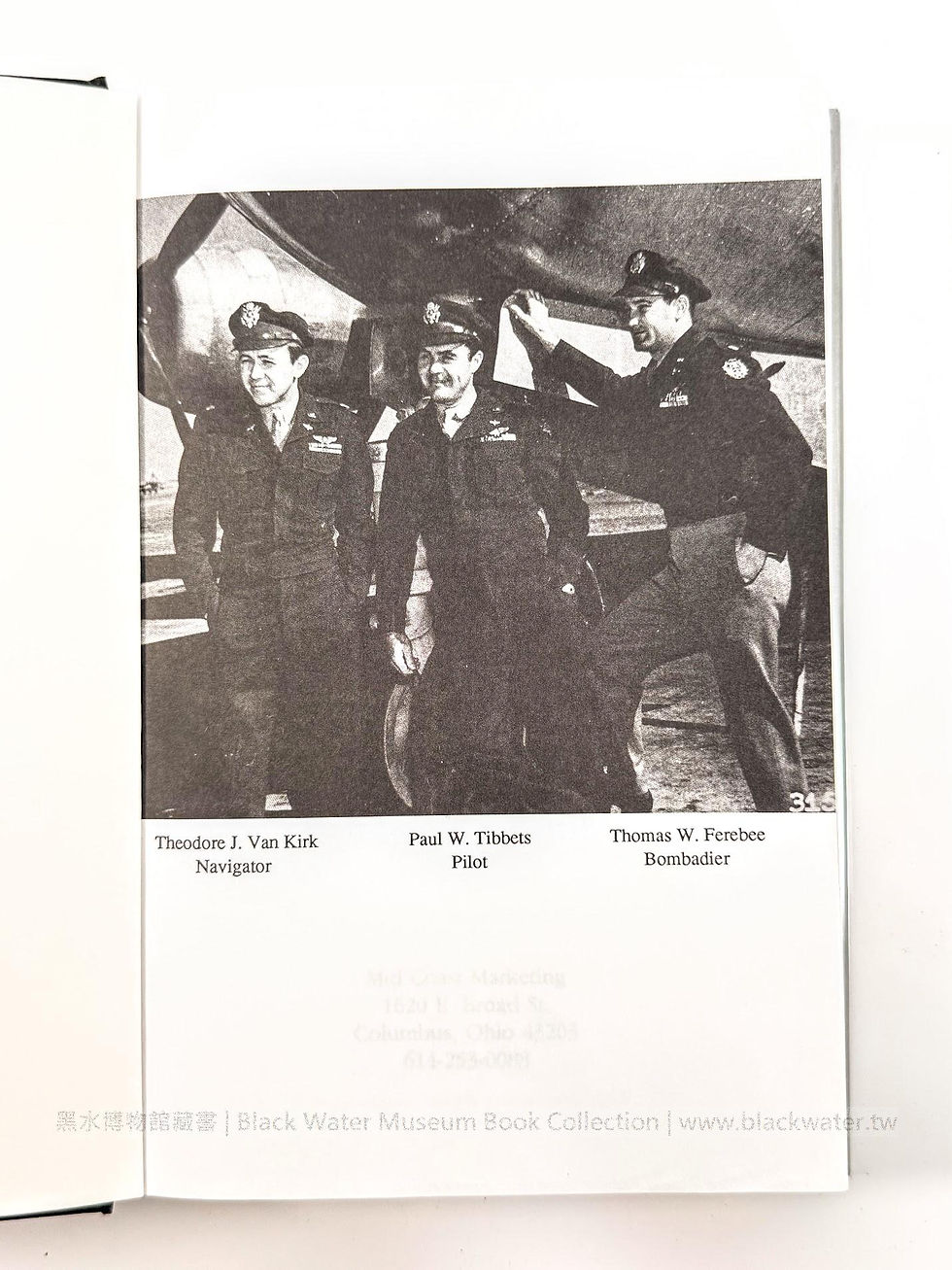
根據館藏內頁印有國際標準書號(ISBN 0-9703666-0-4)與條碼。此外,書內附有一幀珍貴的黑白歷史照片,呈現「伊諾拉·蓋伊號」三位機組員於轟炸機前的合影。
館藏版權頁標示本書版權(Copyright)由保祿·提貝茨本人於1998年全權擁有,並註明於美國印製(Printed in the United States of America)。而緊鄰版權頁的獻詞頁(Dedication)上,印有一段深具歷史意義的獻詞:「To the memory of my mother, Enola Gay Tibbets, whose quiet faith and support gave me courage in many trying moments of combat, this book is dedicated. Paul Warfield Tibbets」(謹以此書紀念我的母親——伊諾拉·蓋伊·提貝茨。她那沈靜的信仰與支持,在無數艱難的戰鬥時刻中給予了我勇氣。保祿·沃菲爾德·提貝茨)。這段文字不僅深刻表達了提貝茨對母親的感恩與敬意,更直接點出了那架終結二戰的傳奇轟炸機的命名淵源。
封底 (Back Cover)
本書封底印有保祿·提貝茨的照片,並詳列其軍職生涯中獲得的各項卓越勳章與獎章(Military Service Awards and Decorations):
Distinguished Service Cross (傑出服役十字勳章)
Distinguished Flying Cross with one oak leaf cluster (傑出飛行十字勳章附一枚橡葉簇)
Air Medal with three oak leaf clusters (航空獎章附三枚橡葉簇)
Purple Heart (紫心勳章)
Legion of Merit (功績勳章)
European Campaign Medal (歐洲戰役獎章)
Joint Staff Commendation Medal (參謀長聯席會議嘉獎獎章)
European African Middle Eastern Campaign Medal with three bronze service stars (歐洲-非洲-中東戰役獎章附三枚銅質服役星章)
American Defense Service Medal (美國防禦服役獎章)
WWII Victory Medal (第二次世界大戰勝利獎章)
Asiatic Pacific Campaign Medal with two bronze service stars (亞太戰役獎章附兩枚銅質服役星章)
National Defense Service Medal with one bronze service star (國防服役獎章附一枚銅質服役星章)
American Campaign Medal (美洲戰役獎章)
Air Force Outstanding Unit Award (空軍傑出單位獎)
Air Force Longevity Service Award with one silver loop (空軍長期服役獎章附一枚銀質扣環)
封底下方收錄了兩位空軍傳奇將領的背書,以及提貝茨本人對廣島任務的堅定自述:
"General Tibbets was an outstanding pilot, officer and group commander. I am delighted that the story of this fine officer and his accomplishments are finally being told." — J.H. Doolittle, Lt. General, USAF, Retired.
(「提貝茨將軍是一位傑出的飛行員、軍官與大隊指揮官。我很高興這位優秀軍官的故事及其成就能夠最終公諸於世。」—— J.H. 杜立德,美國空軍退役中將)
"General Tibbets' mission to Hiroshima was an example of textbook perfection." — Curtis E. LeMay, General USAF, Retired.
(「提貝茨將軍的廣島任務是教科書般完美的典範。」—— 柯蒂斯·李梅,美國空軍退役上將)
"On August 6, 1945 as the Enola Gay approached the Japanese city of Hiroshima, I fervently hoped for success in the first use of a nuclear type weapon. To me it meant putting an end to the fighting and the consequent loss of lives. In fact, I viewed my mission as one to save lives rather than take them. The intervening years has brought me many letters and personal contacts with individuals who maintain that they would not be alive if it had not been for what I did. Likewise, I have been asked in letters and to my face if I was not conscious stricken for the loss of life I caused by dropping the first atomic bomb. To those who ask, I quickly reply, 'NOT IN THE LEAST'." — Paul W. Tibbets, Brig. General USAF, Retired.
「1945年8月6日,當伊諾拉·蓋伊號接近日本廣島市時,我熱切期盼這首次使用核子型武器能取得成功。對我而言,這意味著終止戰鬥與隨之而來的生命損失。事實上,我將我的任務視為拯救生命,而非奪取生命。這些年來,我收到許多信件,也親自接觸過許多人,他們堅稱如果沒有我當時的行動,他們今天就不會活著。同樣地,我也常在信中或當面被問及,對於投下第一顆原子彈所造成的生命損失,我是否感到良心不安。對於那些提出這問題的人,我總是迅速回答:『一點也不會』。」—— 保祿·W·提貝茨,美國空軍退役准將
致謝 (Acknowledgments)
致謝頁記錄了作者保祿·提貝茨於民國87年(1998)7月1日寫下的全文,揭示了本書的重寫與發行歷程:
「I am deeply indebted to my good friend Gerry Newhouse for his persistent encouragement during the process of the rewriting of Flight of the Enola Gay. Throughout it all, his advice and counsel have been invaluable to me. His marketing savvy has been crucial to this project. Moreover, he has been a good traveling companion as I have hopscotched around the country to meet public-appearance dates.
I am grateful, as well, to Columbus Dispatch columnist Mike Harden for his editorial input in fine-tuning the writing as I added chapters to the book and revised several that required updating.
Paul W. Tibbets
July 1, 1998」
(我深深感謝我的好朋友傑瑞·紐豪斯 (Gerry Newhouse),在重寫《伊諾拉·蓋伊號的飛行》的過程中給予我持續的鼓勵。在整個過程中,他的建議和忠告對我來說是無價的。他的行銷才能對這個計畫至關重要。此外,當我在全國各地奔波以配合公開露面的日程時,他也是一位很好的旅行伴侶。我也很感激《哥倫布快訊》(Columbus Dispatch) 專欄作家麥克·哈登 (Mike Harden),在我不斷為本書增加章節並修改幾處需要更新的內容時,他提供了編輯方面的意見,對文稿進行了潤飾。保祿·提貝茨,民國87年(1998)7月1日。)
前言 (Introduction)
本書的前言("Mr. Tibbets" —An Introduction)以第三人稱視角深刻描寫了提貝茨將軍的戰後生活與其出版本書的初衷,全文如下:
「The '60s vintage ranch-style house that Paul Tibbets calls home is anonymously Middle America. To be sure, there are personal touches that mark the taste and style of the occupants, though nothing to suggest that its owner played one of the most crucial roles in the history of American warfare. No medals or ribbons are showcased to awe visitors to the home. None of the newspapers in which Paul Tibbets was page-one news are framed for posterity. A stranger would have no clue that he had entered the home of the man who led the first A-bomb mission to Hiroshima, who commanded history's only nuclear strike force and planned the strategy vital to bringing an unexpectedly swift end to World War II. His actions were indispensable to sparing hundreds of thousands of lives—both American and Japanese—that likely would have been lost had an amphibious invasion of the Japanese home islands been necessary. Nothing in Tibbet's home salutes his distinction as the pilot who led the first American daylight raid on Hitler's occupied Europe and the first mass attack across the Channel; that he was entrusted to fly Mark Clark on his celebrated secret rendezvous with the French in North Africa or that he flew General Eisenhower to Gibraltar for the start of the American invasion. It is not for want of a sense of history that his home is void of the mementoes or citations acknowledging his niche in it. The last thing Paul Tibbets would make of his home is a shrine to his achievements.
Affable, unassuming, he wears his 83 years as one might a comfortable old sweater. The thick mane of black hair has gone silver. The penetrating blue eyes miss little, as anyone who has ever shot sporting clays with Tibbets will attest. Though not unwilling to discuss his military achievements, he seldom, if ever initiates such talk.
The pursuit of perfection has been and continues to be the hallmark of Tibbets life.
To some, it might seem that any assignment the military handed Tibbets after the Hiroshima mission would have been anticlimactic. Nothing could be further from the truth. Once the war had ended, there were other assignments—some important, some routine. He invested all of his vigor, intellect and high standards in all of those. The Air Force found his expertise particularly useful as it began development of the first successful jet bomber, the B-47, in conjunction with the Boeing Airplane Company. More than once, his name was called to troubleshoot and straighten out faltering air divisions. He was assigned to the NATO staff in France and to India as deputy commander of the American Military Mission.
But those tasks were hardly as breathtakingly exciting as those he had fulfilled during the war over the skies of Europe, North Africa and the Pacific. In combat and command positions, he had performed brilliantly.
Those familiar with his wartime record expected that Tibbets would eventually attain three-star or even four-star rank. But with the end of the war, traditional military politics took over. There suddenly seemed little demand for the Tibbets brand of perfection. At the very top, competent men remained in charge but, at the next level, many officers whose greatest skill was pulling strings insinuated themselves into the diminishing number of key jobs. Tibbets had been too busy with important wartime assignments to polish apples. He had even made a number of enemies by standing up to superior officers when he considered it necessary. He had no patience with mediocrity, particularly when it threatened the success of a wartime mission or the lives of his men.
Retiring from the Air Force with the rank of brigadier general, he was soon invited to join Executive Jet Aviation Inc., based in Columbus, Ohio. After many successful years as president of that company, he stepped aside from his second career in 1986.
Never a seeker of publicity, he has nonetheless occasionally granted the requests of newspapers and magazines for interviews. He prefers, however, to remain out of the limelight. Even during the bitter and protracted fight that raged about the Smithsonian Institution's initial plans for an exhibit centering on the A-Bomb mission and utilizing a largely dismembered Enola Gay, his preference was to work vigorously, and almost exclusively, behind the scenes.
As the son of Enola Gay Tibbets, he is proud that his mother's curiously melodious name is better known than his own. This red-haired daughter of an Iowa farm family had a profound influence on his life, and he never lost sight of the fact that she stood by him with confidence when he gave up plans for a career as a physician to become a military aviator. On the day before the Hiroshima flight, when it came time to choose a name for his B-29 bomber, his thoughts were of her.
For years, Tibbets resisted suggestions by friends that he write his own account of the most cataclysmic chapter in the history of warfare. From the spear to the crossbow to the introduction of gunpowder and powerful explosives, his was the most fearsome of the many weapons that man has devised.
This book is more than a story of the atomic bomb, however. Because of the misleading information that has gained worldwide circulation, the author has chosen to tell the entire story of his life so that readers may learn of the typically American background of this dedicated soldier who would rather fly civilian jets through a peaceful sky than drop bombs on enemy targets.
It is the story of a quiet, unpretentious, yet dignified man who, with great skill and unquestioning faith in the judgment of those who led his country and its allies, brought a hasty end to the most terrible of all wars.」
保祿·提貝茨所稱之為家的那棟60年代復古牧場風格房屋,是典型的美國中部尋常人家。誠然,有些個人風格的點綴標誌著居住者的品味與格調,但沒有任何跡象表明其主人曾在美國戰爭史上扮演過最關鍵的角色之一。家裡沒有展示任何獎章或綬帶來讓訪客驚嘆。沒有任何將保祿·提貝茨作為頭版新聞的報紙被裝裱起來傳給後代。陌生人絕對無從得知,他走進的這位主人的家,曾領導了首次對廣島的原子彈轟炸任務,指揮了歷史上唯一的核子打擊部隊,並策劃了為第二次世界大戰帶來出乎意料迅速終結的關鍵戰略。他的行動對於拯救數十萬人的生命——包括美國人和日本人——是不可或缺的,如果必須對日本帝國本土進行兩棲登陸,這些生命很可能就會白白喪失。在提貝茨的家中,沒有任何東西用來致敬他的卓越成就:他是第一位領導美國在白天對希特勒佔領下的歐洲進行空襲的飛行員,也是第一位領導飛越英吉利海峽進行大規模攻擊的飛行員;他受託駕駛飛機載著馬克·克拉克(Mark Clark)前往北非與法國人進行著名的秘密會合,他也曾駕駛飛機載著德懷特·艾森豪將軍前往直布羅陀,為美國的入侵拉開序幕。他的家中之所以沒有任何紀念品或獎狀來承認他的歷史地位,並非因為缺乏歷史感。保祿·提貝茨最不願意做的事情,就是把他的家變成供奉他成就的神龕。
和藹可親、謙遜低調,他將自己83歲的高齡穿得像件舒適的舊毛衣。那頭濃密的黑髮已經變成了銀色。那雙銳利的藍眼睛幾乎不會漏掉任何細節,任何曾與提貝茨一起打過飛靶的人都能證明這一點。雖然他並不排斥討論自己的軍事成就,但他很少,甚至從不主動發起這類談話。
追求完美一直且將繼續是提貝茨人生的標誌。
對某些人來說,軍方在廣島任務後交給提貝茨的任何任務似乎都難免有些虎頭蛇尾。但事實絕非如此。戰爭結束後,還有其他任務——有些很重要,有些是例行公事。他在所有這些任務中投入了全部的精力、智慧和高標準。空軍發現他的專業知識特別有用,因為空軍開始與波音飛機公司合作開發第一架成功的噴射轟炸機 B-47。他的名字不止一次被點名去解決問題並整頓搖搖欲墜的飛行部隊。他被派往法國的北約參謀部,並作為美國軍事代表團的副司令前往印度。
但那些任務幾乎都不如他在歐洲、北非和太平洋上空戰爭期間所履行的任務那般驚心動魄。在戰鬥和指揮崗位上,他的表現都非常出色。
那些熟悉他戰時記錄的人曾預期提貝茨最終會晉升為三星甚至四星上將。但隨著戰爭的結束,傳統的軍隊政治接管了一切。對提貝茨那種完美主義的需求似乎突然變少了。在最高層,有能力的人仍然掌權,但在下一層,許多最擅長拉關係的軍官卻鑽進了數量日益減少的關鍵職位。提貝茨一直忙於重要的戰時任務,沒時間去拍馬屁。他甚至因為在必要時頂撞上級長官而樹立了不少敵人。他對平庸沒有耐心,尤其是當平庸威脅到戰時任務的成功或他部下的生命時。
以准將軍階從空軍退役後,他很快受邀加入總部位於俄亥俄州哥倫布市的商務噴射機航空公司 (Executive Jet Aviation Inc.)。在擔任該公司總裁多年並取得成功後,他於民國75年(1986)從他的第二份事業中退了下來。
他從不尋求出名,但偶爾也會答應報紙和雜誌的採訪要求。然而,他更喜歡遠離聚光燈。即使在圍繞史密森尼學會最初計畫以原子彈任務為中心並利用被嚴重肢解的「伊諾拉·蓋伊號」進行展覽而引發的激烈且曠日持久的紛爭中,他還是傾向於積極地,且幾乎是專注地在幕後工作。
作為伊諾拉·蓋伊·提貝茨的兒子,他感到自豪的是,他母親那個奇特而悅耳的名字比他自己的名字更為人所知。這位愛荷華州農家紅髮女兒對他的一生產生了深遠的影響,他從未忘記,當他放棄當醫生的計畫而成為一名陸軍飛行員時,她滿懷信心地支持他。在飛往廣島的前一天,到了為他的 B-29 轟炸機命名之際,他腦海中浮現的都是她的身影。
多年來,提貝茨一直拒絕朋友們的建議,即讓他寫下自己在戰爭史上這最具災難性篇章的個人記述。從長矛到弩,再到火藥和強力炸藥的引入,他所使用的是人類設計的眾多武器中最令人恐懼的一種。
然而,這本書不僅僅是關於原子彈的故事。由於誤導性資訊在世界範圍內廣泛流傳,作者選擇講述他一生的完整故事,以便讀者可以了解這位典型美國背景、盡心盡責的士兵,比起向敵人目標投擲炸彈,他寧願在和平的天空中駕駛民用噴射機。
這是一個安靜、毫不矯揉造作卻又莊嚴肅穆的男人的故事,他憑藉著高超的技術和對領導其國家及盟國高層之決策抱持著堅定不移的信念,為這場史上最慘烈的戰爭畫下了迅速的休止符。
第1章:奇異的命運 (1 Strange Destiny)
本書第一章「奇異的命運」完整收錄了提貝茨將軍對執行廣島任務當下的震撼、對戰爭殘酷的省思,以及嚴正駁斥戰後「歷史修正主義」究責的強硬立場。全文如下:
「From the pilot's seat of my airplane, I saw the city shimmering 6 miles below in the bright sunlight of an August morning. Suddenly there was a blinding flash beside which the sun grew dim. In a millionth of a second, the shimmering city became an ugly smudge.
For eleven months I had worked day and night to plan the delivery of that bright and devastating flash. Now that I could say "mission accomplished," I was stunned.
What strange destiny had brought me over this alien island, half a world away from my birthplace in Quincy, Illinois, to keep this appointment with history?
My eleven companions and I were improbable choices to become the messengers of a war god more terrible than any who had walked this earth in all the centuries past. We were no Genghis Khans, no Tamerlanes, no Julius Caesars or Napoleons. Yet any of these ruthless warriors, whose deeds are written in blood across the pages of human history, would have trembled at what we had done.
Nothing in their experience as practicing agents of death and destruction would have prepared them for the awful sight I had just witnessed on the morning of August 6, 1945, and for which I was actually responsible.
I shall never forget the sight of that bright purple cloud boiling upward for ten miles above a dying city, which was suddenly blanketed by an ugly mass of black smoke that resembled, more than anything else I can think of, a pot of bubbling hot tar.
Awe and astonishment were my feelings as I viewed this scene. Although briefed in advance on the potential effect of this incredible new weapon, I was unprepared for what I saw. The shock was such that I don't remember what was said by me or my fellow crewmen at that moment, except that everyone reacted in stunned disbelief.
A movie reenactment of the historic flight had me saying, "My God, what have we done?"
I'm sure those dramatic words were not spoken, but they probably reflect the thoughts of all 12 men aboard the Enola Gay, a B-29 bomber that I had named for my mother.
We were certainly aware that thousands of people were dying at that moment on the ground below. It is not easy for a soldier to be detached from the misery he has created. Every fighting man with normal sensitivity, even if he has simply pulled a rifle trigger and slain a fellow soldier of another nationality, is painfully aware that he has brought tragedy to some household.
Let it be understood that I feel a sense of shame for the whole human race, which through all history has accepted the shedding of human blood as a means of settling disputes between nations. And I feel a special sense of indignation at those who condemn the use of a nuclear explosive while having no lament for the fire-bombing attacks in the same war on the city of Tokyo, where thousands of civilians were literally burned to death in a single night, and on Dresden, a great German city that was all but leveled in a dreadful mass attack.
Only a fool speaks of humane warfare. There is no such thing, as General Sherman and other competent witnesses have testified. It has the smell of hypocrisy when self-proclaimed humanitarians draw a distinction between an acceptable and an intolerable brand of human cruelty. Let those who honestly desire peace among nations also condemn all forms of international terrorism that are meant, by their perpetrators, to set the stage for war.
As often happens after a cataclysmic event, rumors have spread that some form of divine retribution has overtaken a majority of those who participated in the Hiroshima attack. It has been implied that some of us have died mysteriously and that others have fallen victim to disease or insanity.
For at least 20 years, the anniversary of Hiroshima would bring telephone calls from news media all over the country, ostensibly to request interviews but actually, and not so subtly, to inquire about my health and mental conditions. Always, the reporter seemed surprised and a bit disappointed to learn that I was leading a perfectly normal life and had no intention of repudiating my role in the historic event.
The Japanese seem to be more understanding. I was visited a number of years ago by newsmen from Japan and once submitted to a taped television interview which was broadcast in that country. In each case, the interviewers asked no hostile questions and gave no sign that they regarded me as a monster whose superweapon had destroyed two of their cities and killed 150,000 of their countrymen. Perhaps they understood, better than many Americans, that the nuclear strikes had shortened the war to the extent that Japan had been spared a far greater toll in the months ahead. They may have sensed the possibility that the bomb had saved their own lives.
Today's controversy over the use of the atomic bomb is interesting in view of the fact that in 1945, Americans were almost unanimously thankful that such a miracle weapon had been developed. The A-bomb ended the war and brought the boys home, and that was what counted. Thousands of those servicemen who returned to their families would have been dead had it not been for this terrible new instrument of war.
During the four years of the bomb's development, there was no suggestion that it should not be put to actual use. The scientists worked around the clock to perfect this weapon with full knowledge that, if they were successful, their handiwork would wreak appalling destruction on people and property.
President Roosevelt and Prime Minister Churchill were in complete agreement on the bomb, and both of these men are regarded as enlightened humanitarians. The ultimate order to drop the bomb came from President Truman. He did not hesitate despite last-minute suggestions from a group of scientists to warn Japan in advance and then make a well-publicized demonstration blast at sea, somewhere off that country's coastline. Neither the President nor his military advisers were willing to risk the fiasco that such a plan might have produced. First, there was the chance of failure. Second, the Japanese might well have decided to prevent the demonstration by shooting down the bomb-carrying plane.
Pacifists and leaders of left-wing thought in this country and overseas pointed the finger of shame at the United States during the Cold War years for having unleashed a cosmic dragon upon the world. They sought to haunt all Americans with a feeling of guilt over the dead in Hiroshima and Nagasaki. Just as we were exhorted during the war to "remember Pearl Harbor," we were now being counseled to "forget Hiroshima."
Aware that this outcry might have a psychological effect on the lives of those who participated in the mission and its planning, President Truman summoned me to the White House one day and said: "Don't you ever lose any sleep over the fact that you planned and carried out that mission. It was my decision. You had no choice."
His advice was appreciated but unnecessary. This was exactly my view from the start. But it was good to know that we had a president with the guts to take the heat. I have often thought of the well-known sign on his desk: "The buck stops here."
Some have said that American guilt was compounded by the fact that the bomb was used against the Oriental race. It was implied that we would not have employed it against Caucasians.
This is nonsense. The bomb was conceived in part by refugees from Nazi tyranny. Germany was already known to be working on such a weapon and Japanese scientists were engaged in similar advanced research. When I was assigned to organize a bomb group and devise a method of delivery, the war in Europe was in full fury.
My instructions were to create an elite bombing force, comprised of the best pilots and bombardiers in service, with the understanding that, when trained, they would be divided into two groups: one to be sent to Europe and the other to the Pacific.
There was no Japanese target priority. All our early planning assumed that we would make almost simultaneous bomb drops on Germany and Japan. However, we had not reached the point of discussing the most likely targets in Germany at the time the war in Europe was over, for completion of the bomb was still three months away.
It is my belief that Berlin would have shared the fate of Hiroshima if the war in Europe had still been in progress in August 1945.
From the pilot's seat of the Enola Gay, I saw Hiroshima in the moments before it disappeared. The city has now been rebuilt; for that I am glad. I visited the ruins of Nagasaki soon after the attack by another plane of the squadron I commanded, and saw for myself the terrifying results of the atom.
In the three decades since these events, the so-called "Little Boy" and "Fat Man" bombs we dropped have become obsolete, as has the method of delivery. In the United States, hundreds of missiles with nuclear warheads many times more powerful are poised and zeroed in on Soviet targets. In Russia, an estimated equal number are aimed at our cities and military installations. Nuclear-armed submarines from both sides range across the world's oceans. Like it or not, we live a precarious existence under the shadow of the atom.
In that context, it is probably no wonder that the United States appears embarrassed by its invention of nuclear warfare. However, the world's smaller and weaker nations might well ponder the probable consequences if the secret had fallen first and exclusively into the hands of an aggressor nation.
During World War II, when the atomic bomb was developed, it's a safe guess that 99.9 percent of the American people would have said "yes" if the question of its use had been put to a vote. No one suggested that our war effort should be less than 100 percent. The enemy wrecked Rotterdam and Coventry and fire-bombed London. We made rubble out of Dresden, Essen, and Berlin. The Germans and Russians fought a battle that destroyed Stalingrad. Our bombers in the Pacific laid waste a dozen or more Japanese cities, killing untold thousands of civilians in nighttime terror raids. Our purpose was to bring the empire to its knees. We didn't very much care how we did it.
Yet today, our employment of this war-ending weapon remains a matter of controversy, kept alive by a relatively small number of people. My B-29 bomber, Enola Gay, was allowed to suffer from weather and vandalism for years in a remote section of Andrews Air Force base outside Washington, D.C. Today it is in a Maryland warehouse partially restored through the work of a volunteer hobbyist, Vince LoPrinzi, an Allegheny Airlines pilot. The Smithsonian Institution, which holds title to the plane, had no space in its new Air and Space Museum for an aircraft of this size. It is now scheduled for permanent display in the National Atomic Museum at Kirtland Air Force base, Albuquerque, New Mexico, where exhibition facilities are being expanded.
By contrast, the Enola's sister plane, Bock's Car, occupies a conspicuous place of honor in the Air Force Museum at Wright-Patterson Air Force base near Dayton, Ohio. There is no apology for the display of this plane, which I assigned to carry the plutonium bomb to Nagasaki. This exhibit is a leading attraction in a museum that is jammed with military aircraft dating back to before World War I.
There were disappointments and frustrations in my military career that need not be dwelt on here because they will become apparent to the reader of this autobiographical narrative. The fact remains that my 30 years in the service were rewarding in many ways.
It was no infatuation with military life that led me to give up the prospects of a medical career to join the Army Air Corps in the pleasant, peaceful days before World War II. On reflection, I am sure that I gave no more than a passing thought to the prospect of ever being involved in deadly combat. It was, rather, my love affair with the airplane that drew me into service. And that love affair has continued throughout my life.」
從我飛機的駕駛座上,我看到六英里下方那座城市在八月早晨明亮的陽光下閃爍著微光。突然間,一道令人目眩的閃光出現,就連太陽在它旁邊都顯得黯淡。在百萬分之一秒內,這座閃爍的城市變成了一團醜陋的汙跡。
十一個月來,我日以繼夜地工作,計畫投下那道明亮且具毀滅性的閃光。現在我可以說「任務完成」了,但我卻深受震撼。
是什麼奇異的命運將我帶到了這個異國島嶼上空,遠離我伊利諾州昆西市(Quincy, Illinois)的出生地半個地球之遙,來赴這場與歷史的約會?
我和我的十一位同伴,是不太可能被選中成為比過去幾個世紀在這世上行走過的任何戰神都更可怕的使者的。我們不是成吉思汗,不是帖木兒,不是凱撒大帝,也不是拿破崙。然而,這些在人類歷史篇章中用鮮血寫下事蹟的冷酷戰士們,若看到我們所做的事,都會不寒而慄。
在他們作為死亡與毀滅代理人的經驗中,沒有任何事物能讓他們準備好面對我在1945年8月6日早晨剛剛目睹的,並且我實際上需對此負責的可怕景象。
我永遠不會忘記那片明亮的紫色雲彩在一座垂死之城上空翻滾上升十英里的景象,這座城市突然被一團醜陋的黑煙覆蓋,這團黑煙比我能想到的任何東西都更像是一鍋冒著泡的熱柏油。
當我看著這景象時,我的感覺是敬畏和震驚。雖然事前已簡報過這種令人難以置信的新武器的潛在威力,但我對我所看到的一切毫無準備。那種震驚如此之大,以至於我不記得那一刻我或我的機組員說了什麼,只記得每個人都表現出震驚的難以置信。
在一部重現這次歷史性飛行的電影中,我說了:「我的天,我們做了什麼?」
我很確定當時並沒有說出那句戲劇性的話,但它們可能反映了「伊諾拉·蓋伊號」上所有12名機組員的想法,這是一架我以母親名字命名的B-29轟炸機。
我們當然意識到在那一刻,下方地面上有成千上萬的人正在死去。對於一個軍人來說,要從他所製造的悲慘中抽離出來並不容易。任何一個有著正常敏感度的戰鬥人員,即使他只是扣動步槍扳機殺死了另一個國籍的士兵,也會痛苦地意識到他為某個家庭帶來了悲劇。
請理解,我對整個人類感到一種羞愧感,因為在整個歷史中,人類都接受流血作為解決國家間爭端的一種手段。同時,我對那些譴責使用核子爆炸物,卻對同一場戰爭中對東京的燃燒彈攻擊(數千平民在一個晚上被活活燒死)沒有任何哀悼,以及對德勒斯登(一座幾乎在可怕的大規模攻擊中被夷為平地的偉大德國城市)沒有任何同情的人,感到一種特殊的憤慨。
只有傻瓜才會談論人道的戰爭。正如薛曼將軍和其他有能力的見證人所證實的那樣,根本沒有這種東西。當自封的人道主義者在可接受與不可容忍的人類殘酷行為之間劃清界線時,這聞起來就像是偽善。讓那些真心渴望國家間和平的人,也譴責所有由肇事者意圖為戰爭搭建舞台的國際恐怖主義形式吧。
正如在一場大災難之後經常發生的那樣,謠言四起,說某種形式的神譴已經降臨在大多數參與廣島襲擊的人身上。有人暗示我們中的一些人已經神祕死亡,而其他人則成了疾病或精神失常的受害者。
至少有二十年的時間,廣島的紀念日會帶來全國各地新聞媒體的電話,表面上是要求採訪,但實際上卻不太隱晦地探問我的健康和精神狀況。記者總是顯得驚訝,甚至有些失望地得知我過著完全正常的生活,並且沒有打算否定我在那次歷史事件中所扮演的角色。
日本人似乎更能理解。多年前,來自日本的新聞記者拜訪了我,並且我也曾接受過一次錄影的電視採訪,該採訪在那個國家播出。在每一次採訪中,採訪者都沒有提出充滿敵意的問題,也沒有表現出他們把我當作一個用超級武器摧毀了他們兩座城市、殺死了15萬同胞的怪物。也許他們比許多美國人更了解,核武打擊縮短了戰爭,使得日本免於在未來的幾個月裡付出更巨大的代價。他們可能已經感覺到,這顆炸彈拯救了他們自己的生命。
鑑於1945年時美國人幾乎一致感激發展出這樣一種奇蹟武器,今天對於使用原子彈的爭議顯得很有趣。原子彈結束了戰爭,讓男孩們回家了,這才是最重要的。如果沒有這個可怕的新戰爭工具,成千上萬回到家人身邊的軍人早就死了。
在原子彈發展的四年裡,從沒有人建議不應該將它投入實際使用。科學家們夜以繼日地工作以完善這種武器,他們完全清楚,如果他們成功了,他們的作品將對人員和財產造成可怕的破壞。
羅斯福總統和邱吉爾首相對原子彈的意見完全一致,而這兩個人都被認為是開明的人道主義者。投擲原子彈的最終命令來自杜魯門總統。儘管有一群科學家在最後一刻建議事先警告日本,然後在該國海岸線外的海上進行一場公開的展示性試爆,但他毫不猶豫。總統和他的軍事顧問都不願意冒險去承受這種計畫可能產生的慘敗。首先,有失敗的機會。其次,日本人很可能會決定擊落攜帶炸彈的飛機來阻止這場試爆。
這個國家的和平主義者和左翼思想領袖以及海外的人士在冷戰期間對美國指指點點,指責美國向世界釋放了一條宇宙之龍。他們試圖用對廣島和長崎死難者的內疚感來困擾所有美國人。就像我們在戰爭期間被勸誡要「記住珍珠港」一樣,我們現在被建議要「忘記廣島」。
意識到這種強烈抗議可能會對那些參與任務及其計畫的人的生活產生心理影響,杜魯門總統有一天把我召喚到白宮,並說:「你千萬不要因為你計畫並執行了那次任務而失眠。那是我的決定。你沒有選擇。」
我很感激他的建議,但這是不必要的。這正是我一開始的看法。但很高興知道我們有一位有膽量承擔壓力的總統。我經常想到他桌上那個著名的標誌:「責任止於此」(The buck stops here)。
有人說美國的內疚感因為炸彈是對東方人種使用的這個事實而加劇。他們暗示我們不會對白種人使用它。
這簡直是胡說八道。這顆炸彈的部分構想是由逃離納粹暴政的難民提出的。眾所周知,德國已經在研發這種武器,而日本科學家也參與了類似的先進研究。當我被指派去組織一個轟炸大隊並設計一種投遞方法時,歐洲的戰爭正如火如荼。
我接到的指示是建立一支精銳的轟炸部隊,由服役中最優秀的飛行員和轟炸員組成,並了解到,當訓練完成後,他們將被分成兩組:一組派往歐洲,另一組派往太平洋。
並沒有日本目標優先這回事。我們所有的早期計畫都假設我們將對德國和日本進行幾乎同時的轟炸。然而,在歐洲戰爭結束時,我們還沒有討論到德國最可能的目標,因為炸彈還需要三個月才能完成。
我深信,如果1945年8月時歐洲的戰爭仍在進行,柏林將會與廣島遭受相同的命運。
從「伊諾拉·蓋伊號」的駕駛座上,我看到了廣島消失前幾刻的景象。這座城市現在已經重建;為此我感到高興。在襲擊發生後不久,我乘坐我指揮的中隊的另一架飛機造訪了長崎的廢墟,並親眼看到了原子彈的可怕後果。
在這些事件發生後的三個十年裡,我們投下的所謂「小男孩」和「胖子」炸彈已經過時了,投遞的方法也是如此。在美國,數百枚帶有核子彈頭的飛彈(威力比當時大許多倍)正蓄勢待發,瞄準了蘇聯的目標。在俄羅斯,估計有同等數量的飛彈瞄準了我們的城市和軍事設施。雙方配備核武的潛艦在世界各大洋游弋。不管你喜不喜歡,我們都在原子的陰影下過著朝不保夕的生活。
在這種背景下,美國似乎對其發明核子戰爭感到尷尬,這也許不足為奇。然而,世界上較小和較弱的國家最好仔細思考一下,如果這個秘密首先且獨家落入一個侵略國的手中,可能會有什麼後果。
在二戰期間,當原子彈被研發出來時,我們可以肯定地猜測,如果將是否使用它的問題付諸表決,99.9% 的美國人民會說「是」。沒有人建議我們的戰爭努力應該低於100%。敵人摧毀了鹿特丹和考文垂,並用燃燒彈轟炸了倫敦。我們把德勒斯登、埃森和柏林變成了廢墟。德國人和俄羅斯人打了一場摧毀史達林格勒的戰役。我們在太平洋的轟炸機摧毀了十幾個或更多的日本城市,在夜間的恐怖空襲中殺死了無數平民。我們的目的是讓這個帝國屈服。我們並不太在乎我們是怎麼做到的。
然而時至今日,我們使用這種結束戰爭的武器仍然是一個爭議問題,而這股爭議僅是由相對少數的人在持續挑起。我的B-29轟炸機「伊諾拉·蓋伊號」,多年來被棄置在華盛頓特區外圍安德魯空軍基地的一個偏僻角落,任憑風雨侵蝕與人為破壞。如今,它被安置於馬里蘭州的一處倉庫中,多虧了一位熱心的志工——阿利根尼航空的飛行員文斯·洛普林齊(Vince LoPrinzi)的努力,才得以進行部分修復。擁有這架飛機所有權的史密森尼學會表示,其新建的國家航空太空博物館內,並沒有多餘的空間來容納這般龐大體積的飛機。目前,它已預定將於新墨西哥州阿爾伯克基市(Albuquerque)科特蘭空軍基地(Kirtland Air Force base)內的國家原子能博物館進行永久展出,該館的展覽設施目前正在擴建當中。
相比之下,伊諾拉號的姊妹機『博克斯卡號』(Bock's Car),則在俄亥俄州代頓市(Dayton)附近的萊特-派特森空軍基地的美國空軍博物館裡,佔據了一個顯眼且備受尊崇的位置。館方對於展出這架飛機沒有絲毫的歉意與避諱——當年正是我指派它載運鈽原子彈前往長崎的。該博物館館藏豐富,擠滿了可追溯至第一次世界大戰前夕的各類軍用飛機,而這架戰機的展出,更是館內最引人注目的焦點之一。
在我的軍旅生涯中,也曾有過失望與挫敗。這些在此無須贅述,因為閱讀這部自傳的讀者自然會明瞭。但不可否認的事實是,我這三十年的服役生涯在許多方面都令我獲益良多。
在二戰爆發前那段愉悅、祥和的日子裡,讓我放棄醫學生涯的平坦前程而加入陸軍航空隊的,並非出於對軍旅生涯的迷戀。現在回想起來,我敢肯定,對於將來是否會捲入殊死搏鬥之中,我頂多只是腦海中閃過一絲念頭,並未深思。更確切地說,是出於對飛行的熱愛,才吸引我入伍服役。而這份熱愛,就這麼延續了我的一生。
書籍目錄 (Contents)
此書完整目錄詳列如下,記錄了保祿·提貝茨從早期軍旅生涯到二戰主要任務,以及戰後歲月的完整見證:
Acknowledgements (致謝) ix
Introduction (前言) 1
1 Strange Destiny (奇異的命運) 5
2 From Corn Belt to Sun Belt (從玉米帶到陽光帶) 11
3 Target: Hialeah (目標:海厄利亞) 19
4 A Dose of Discipline (紀律的洗禮) 24
5 The Big Decision (重大決定) 32
6 Winning My Wings (贏得飛行翼) 40
7 Fort Benning (本寧堡) 49
8 Skeet-shooting with George Patton (與喬治·巴頓的飛靶射擊) 55
9 Flying Low (低空飛行) 62
10 Flying Fortress Training (飛行堡壘訓練) 66
11 Code Name Bolero (代號:波萊羅) 74
12 Yankee Doodle Goes to Town (洋基嘟嘟進城去) 80
13 Close Calls and Milk Runs (驚險時刻與輕鬆任務) 89
14 Mark Clark's Secret Mission (馬克·克拉克的機密任務) 101
15 Ike Goes to War on a Two-by-Four (艾克踏上簡陋的參戰之旅) 107
16 Bombardment in Africa (轟炸非洲) 113
17 Marauders in Algiers (阿爾及爾的劫掠者) 121
18 The Norstad Incident (諾斯塔德事件) 127
19 Reunion (重逢) 137
20 Flying Blind (盲目飛行) 140
21 Testing the Super Fortress (測試超級堡壘) 146
22 The Flight of the Ladybird: The WASPS and the B-29 (瓢蟲之飛:女子航空勤務飛行隊與B-29) 151
23 My Secret Air Force (我的秘密空軍) 157
24 The Air Base at the End of Nowhere (荒地盡頭的空軍基地) 167
25 Escaping the Shock Wave (逃離衝擊波) 174
26 The Green Hornet Line (青蜂俠航線) 181
27 Manhattan in the Pacific (太平洋上的曼哈頓) 187
28 Taunts and Jibes (嘲諷與挖苦) 196
29 Last-Minute Preparations (最後準備) 204
30 Using Every Inch of the Runway (用盡跑道的每一吋) 215
31 "My God, What Have We Done?" (「我的天,我們做了什麼?」) 224
32 The World Gets the News (世界得知消息) 235
33 The Luck of the Irish (愛爾蘭人的好運) 245
34 End of the War (戰爭結束) 252
35 Fiasco at Bikini (比基尼環礁的惨剧) 257
36 Testing the B-47 (測試B-47) 266
37 "Above and Beyond" (「超越巔峰」) 274
38 Trouble-shooting Years (解決問題的歲月) 280
39 Mission to India (印度任務) 289
40 The Sad Case of Major Eatherly (埃瑟利少校的悲劇) 294
41 Executive Jet (商務噴射機包機事業) 303
42 Reflections (反思) 314
43 The Enola Gay Returns (伊諾拉·蓋伊號的回歸) 322
44 Epilogue (結語) 328
Index (索引) 333
3. 內容考證
《伊諾拉·蓋伊號的回歸》(Return of the Enola Gay)一書發行於 民國87年(1998) ,為保祿·提貝茨(Paul W. Tibbets)早期自傳的擴充與修訂版本。透過全書339頁正文內容與章節結構進行分析,本書籍的內容具備以下考證重點與史料價值:
涵蓋歐洲、北非與太平洋戰區的陸航軍史紀錄 本書雖以「伊諾拉·蓋伊號」為名,但依據章節目錄分析,該書具備廣泛的軍事航空史料價值。詳細記錄了提貝茨在太平洋戰爭之前的歐洲與北非戰區經歷。例如第12章至第16章,記載了他駕駛B-17轟炸機執行任務,以及接送馬克·克拉克將軍與艾森豪將軍(第14、15章)等機密任務的早期軍事生涯。由於提貝茨在二戰初期並非普通飛官,而是已擔任飛行指揮官、編隊領隊及高階將領專機駕駛,這段為研究二戰初期美國陸軍航空隊之戰略轟炸發展,提供兼具第一線飛行經驗與高階指揮層接觸經驗的第一手證言。
B-29研發與女子航空勤務飛行隊(WASP)之歷史補充 第21章至第22章針對B-29「超級堡壘」轟炸機的早期測試提供了重要文獻。其中第22章(瓢蟲之飛:女子航空勤務飛行隊與B-29)記錄了一段較少被提及的航空史實。提貝茨安排WASP飛行員駕駛B-29進行示範飛行。從歷史脈絡來看,此舉並非基於推廣女性權益,而是提貝茨試圖透過「若WASP女飛行員皆能操作,男性飛行員亦無理由推諉」的心理戰術,來降低部隊對新機型早期技術故障的恐懼。此段對於 1940年代 女性軍職人員的實際貢獻與當時軍中性別心理學研究具備高度參考價值。
針對「反核與罪惡感」論述的歷史反擊 書中第40章(埃瑟利少校的悲劇,The Sad Case of Major Eatherly)是研究戰後歷史論述的重要章節。克勞德·埃瑟利為廣島任務中駕駛氣象觀測機「直航號」的機長。戰後埃瑟利因精神狀況成為焦點,於 1950年代 末至 1960年代 間,逐漸被部分反核團體與媒體塑造成「因原爆產生強烈罪惡感而精神失常的懺悔飛行員」形象。此一形象尤其受到奧地利哲學家暨反核人士君特·安德斯(Günther Anders)與埃瑟利通信集出版後的強力推動,使其成為冷戰時期反核論述的重要符號。提貝茨在此章節中,以任務指揮官的視角對埃瑟利的言行與精神狀態進行了強烈的批判與反駁,並強調埃瑟利並非直接投彈機組員。本文反映了「二戰退伍軍人視角」如何與「戰後反核論述」產生激烈碰撞,為研究冷戰時期原爆歷史記憶建構與道德詮釋衝突的第一手文獻。
回應 1990年代 史密森尼爭議的具體文獻 本書的再版寫作動機,直接關聯於 1990年代 初期史密森尼學會(Smithsonian Institution)籌辦原子彈特展所引發的歷史詮釋爭議。提貝茨於第42章(反思)與第43章(伊諾拉·蓋伊號的回歸)中,明確表述其拒絕為投彈決策道歉的立場。此兩章可視為提貝茨對 1990年代 原爆歷史記憶爭議最直接且系統性的回應文獻。
「伊諾拉·蓋伊號」保存狀況的歷史切片 書中詳細記錄了 1990年代 提貝茨視角下「伊諾拉·蓋伊號」的處境。提及該機曾遭棄置於安德魯空軍基地受損,後於馬里蘭州倉庫由志工文斯·洛普林齊(Vince LoPrinzi)進行部分修復,並記載該機預定移往新墨西哥州展出。根據後續歷史紀錄,史密森尼學會最終並未將該機送往新墨西哥州,而是經過全面修復後,於 民國92年(2003) 永久展示於維吉尼亞州的烏德瓦-哈茲中心(Udvar-Hazy Center)。書中的這段記述,完整保留了該機體於最終展示地點確定前,一段充滿不確定性的過渡期「時間切片史料」。
姊妹機「博克斯卡號」(Bockscar) 的展示對比 提貝茨特意在書中將「伊諾拉·蓋伊號」面臨的展示困境,與執行長崎投彈任務的姊妹機「博克斯卡號」進行對比。書中記載博克斯卡號在俄亥俄州萊特-派特森空軍基地博物館獲得毫不避諱的展示位置。事實上,「博克斯卡號」自 民國50年(1961) 起便已收藏於美國空軍國家博物館並公開展示。提貝茨在書中刻意強調此一對比,反映出其個人論點:不滿為何同樣參與廣島與長崎原子彈任務的兩架B-29轟炸機,在戰後公共展示與社會記憶建構過程中,卻獲得截然不同的待遇。
個人從軍動機的歷史自述 在個人軍旅回顧方面(第2章至第6章),記錄了提貝茨的從軍動機。依據第5章(重大決定)內容,他陳述自己放棄醫學前程加入美國陸軍航空隊。提貝茨於回憶錄中表示,其加入陸軍航空隊的主要原因在於對飛行的濃厚興趣,而非基於職業軍人志向。
4. 發行單位沿革
Mid Coast Marketing 是一間設立於美國俄亥俄州哥倫布市(完整登記地址:1620 E. Broad St., Columbus, Ohio 43203,官方網站:www.theenolagay.com)的發行機構。這間機構並非傳統的商業出版社,而是由保祿·提貝茨(Paul W. Tibbets)的晚年友人兼經紀代理人——傑瑞·紐豪斯(Gerry Newhouse)所主導經營的專屬發行平台。
結合提貝茨生前的出版軌跡與歷史事件,該單位的歷史沿革如下:
創立契機與專屬代理 傑瑞·紐豪斯原為哥倫布市當地居民。民國84年(1995)前後,因美國史密森尼學會(Smithsonian Institution)原訂之核爆特展引發爭議,且美國郵政署取消發行原子彈紀念郵票,紐豪斯自行印製發行了民間版抗議郵票與「非發行首日封」(First Day of Non Issue covers)。保祿·提貝茨透過媒體得知此事後,主動聯繫居住於同市的紐豪斯。此次會面促成了兩人的長期合作,紐豪斯隨後成為提貝茨晚年的官方發言人與經紀代理,並成立 Mid Coast Marketing 專責處理其相關業務。
接續早期的「獨立授權」模式 回顧提貝茨的出版史,其傾向將版權交由地區性機構處理。早於 民國78年(1989) ,他便透過位於俄亥俄州哥倫布市近郊的「七葉樹航空圖書公司」(Buckeye Aviation Book Company)發行自傳《伊諾拉·蓋伊的飛行》。至 1990年代 後期,隨著提貝茨與紐豪斯建立合作關係,Mid Coast Marketing 實質上接續了 Buckeye 公司的「官方授權平台」模式,成為其晚年主要的發行管道。
應對史密森尼展覽與重新出版 為重申其對當年投彈決策之立場,提貝茨決定修訂其回憶錄。透過紐豪斯成立的 Mid Coast Marketing,提貝茨於 民國87年(1998) 發行了修訂版回憶錄《伊諾拉·蓋伊號的回歸》(Return of the Enola Gay)。獨立發行確保了提貝茨得以在不受大型商業出版社干預的情況下,完整保留其完整的歷史觀點。
軍事紀念品之發行與統籌 與早期的 Buckeye 公司類似,Mid Coast Marketing 亦負責統籌提貝茨相關的軍事紀念品業務。該機構發行了帶有提貝茨及其他機組員親筆簽名的限量版書籍與歷史照片,並管理其簽名與實體紀念品之流通。
地緣關係 (俄亥俄州哥倫布市) 機構設立於哥倫布市,此地為提貝茨退役後創立商務噴射機包機事業 Executive Jet Aviation (今 NetJets 前身) 及晚年定居處。出版機構設立於此,符合提貝茨與紐豪斯的居住地緣,便於就近處理授權與實體發行事務。
5. 藏品價值
本館藏品《伊諾拉·蓋伊號的回歸》(Return of the Enola Gay)及其發行實體,超越了單純的歷史回憶錄範疇,具備高度的綜合研究與典藏價值。其藏品價值可歸納為以下四個面向:
美國陸軍航空隊發展與戰略轟炸史之第一手文獻 本書在內容上具備極高的軍史研究價值。作者保祿·提貝茨不僅是原爆任務機長,更是具備指揮層級經驗的高階飛行員。書中詳實記錄了從二戰初期 B-17 轟炸機在歐洲與北非戰區的早期行動,到 B-29「超級堡壘」的機密測試,乃至於戰後 B-47 噴射轟炸機的發展。特別是針對女子航空勤務飛行隊(WASP)參與 B-29 測試的心理戰術記錄,提供兼具第一線飛行經驗與指揮層接觸背景的第一手史料,為研究 1940年代 軍事航空科技演進與部隊管理補足了極為珍貴的歷史細節。
冷戰後「原爆歷史記憶爭議」之實體見證 本書的出版時機與動機,賦予了其特殊的歷史地位。作為對 1990年代 史密森尼學會(Smithsonian Institution)原子彈特展爭議的直接回應,提貝茨透過本書對克勞德·埃瑟利(Claude Eatherly)被塑造成「懺悔飛行員」象徵的歷史敘事提出反駁,並重申其拒絕為投彈決策道歉的立場。此外,書中更留存了「伊諾拉·蓋伊號」在永久展示前充滿不確定性的過渡期狀態,並刻意與「博克斯卡號」的展示待遇進行對比。因此,本書不僅是歷史事件的紀錄,更是研究戰後社會如何建構、選擇與詮釋原爆歷史記憶的重要文獻。
特殊「獨立授權發行」模式之文物載體 本藏品由 Mid Coast Marketing 於 民國87年(1998) 發行,此一出版背景賦予了書籍獨特的文物價值。該機構由提貝茨晚年重要友人兼代理人傑瑞·紐豪斯(Gerry Newhouse)所經營,並長期負責其出版與授權業務,接續了早期 Buckeye Aviation Book Company 的模式。這種避開大型傳統出版商的策略,使提貝茨得以在較少受到大型商業出版社編輯方針影響的情況下出版其觀點,並成為提貝茨相關簽名書籍、歷史照片及紀念品流通的重要載體。這使得本藏品成為研究二戰退伍軍人晚年文物實體發行機制的具體實例。
原爆當事人晚年自我歷史定位之文獻價值 本書完成於提貝茨晚年,內容不僅記錄歷史事件本身,更反映其對原爆任務、戰爭倫理、歷史展示與社會記憶等議題的後設思考。作為原爆任務主要當事人的晚年自述,本書保存了其對自身歷史角色與公共形象的最終定位,具備重要的口述史與記憶史研究價值。




Col. Tibbets was solely responsible for the organization, training, and command of the world's first nuclear strike force・ On the morning of August 6, 1945, Col. Tibbets flew the Enola Gay into the future by dropping the world's first atomic bomb on Hiroshima. THIS IS HIS STORY!

出版者 : Mid Coast; 1st版 (1998年8月31日)
語言 : English
Hardcover : 339 頁
ISBN-10 : 0970366604
ISBN-13 : 978-0970366603
PAUL W. TIBBETS
Military Service Awards and Decorations
★ Distinguished Service Cross ★ American Defense Service Medal
★ Distinguished Flying Cross with one oak leaf cluster
★ Air Medal with three oak leaf clusters
★ Purple Heart
★ Legion of Merit
★ European Campaign Medal
★ Joint Staff Commendation Medal
★ European African Middle Eastern Campaign Medal witli three bronze service stars
★ WWII Victory Medal
★ Asiatic Pacific Campaign Medal with two bronze service stars
★ National Defense Service Medal with one bronze service star
★ American Campaign Medal
★ Air Force Outstanding Unit Award
★ Air Force Longevity Service Award with one silver loop
"'General Tibbets was an outstanding pilot, officer and group commander. Iam delighted that
the story of this fine officer and his accomplishments are finally being told. ”
—J.H. Doolittle
Lt. General, USAF, Retired
''General Tibbets" mission to Hiroshima was an example of textbook perfection. ”
—Curtis E. LeMay
General USAF, Retired
On August 6,1945 as the Enola Gay approached the Japanese city of Hiroshima, I fervently boped for success in the first use of a nuclear type weapon. To me it meant putting an end to the fighting and the consequent loss of lives. In fact, I viewed my mission as one to save lives rather than take them. The intervening years has brought me many letters and personal contacts with individuals who maintain that they would not be alive if it had not been for what I did. Likewise, I have been asked in letters and to my face if I was not conscious stricken for the loss of life I caused by dropping the first atomic bomb. To those who askf I quickly reply, "NOT IN THE LEAST”
—Paul W. Tibbets
Brig. General USAF, Retired


留言