
DA PAM 20-67 (中共-猛敵或紙老虎) Communist China A Strategic Survey 1966
DA PAM 20-67 (中共-猛敵或紙老虎) Communist China A Strategic Survey 1966《Black Water Museum Collections | 黑水博物館館藏》

民國55年美軍《共產中國:戰略調查書目》
一、 基本資料 (Bibliographic Information)
原文題名: COMMUNIST CHINA: A STRATEGIC SURVEY: A BIBLIOGRAPHY
中文譯名: 《共產中國:戰略調查書目》(封面漢字仍沿用舊題:中共—猛敵或紙老虎)
文獻編號: Department of the Army Pamphlet 20-67 (DA PAM 20-67)
出版機關: 美國陸軍部總部 (Headquarters, Department of the Army)
發行日期: 民國55年(1966)2月
出版地點: 美國華盛頓特區
語言: 英文(封面含手寫漢字標題)
二、 實體特徵描述 (Physical Description)
裝訂形式: 平裝本 (Paperback),黃色封面設計(與民國51年 DA PAM 20-61 的紅色封面不同)。
尺寸: 約 26 公分 (Quarto)。
頁數: 141 頁(附錄 I),後續包含多幅摺頁圖表與封底口袋地圖。
附件內容 (Attachments):
地圖 (Maps): 附錄 H 之標題頁位於第 139 頁,列有 12 幅地圖清單。依據目錄 (Page viii) 註記 "(Inside back cover)",實體地圖摺頁係收納於封底口袋中。
圖表 (Charts): 附錄 I 之標題頁位於 第 141 頁 (Page 141),包含中共、中華民國政府與國民黨之組織圖摺頁。
清單 (Lists): 目錄頁特別列出附錄 E「於南越擄獲之中共武器清單」(List of Chinese Communist Weapons Captured in South Vietnam) 位於第 125 頁。
三、 內容摘要 (Scope and Content) 本館藏為美軍於越戰激化與中共首次核試爆(民國53年,1964)後,針對亞洲戰略情勢更新的情報書目調查。本書核心內容涵蓋:
扉頁引言 (Frontispiece Quote): 開篇引用格言 "The More We Sweat In Peace, The Less We Bleed In War"(平時多流汗,戰時少流血),並於分析師註記中明確說明本書旨在更新民國51年(1962)出版之 DA PAM 20-61。此設計顯示美軍戰略思維已從單純指陳中共野心,轉向強調自身的長期戰備與預警。
戰略威脅升級: 英文標題改為「戰略調查」(Strategic Survey),收錄關於中共核武發展、中蘇分裂(Sino-Soviet Dispute)及輸出革命的文獻,顯示美軍已將中共視為實質軍事對手。
敵後情報與內部危機: 重點摘要了民國53年(1964)由中華民國反共救國軍突擊福建連江時擄獲 (Seized) 的機密檔案——《連江文件》。美軍以此分析中共公社制度下的社會動盪,高度依賴中華民國政府提供的敵後情報。
國軍防衛實力 (Nationalist Forces on Taiwan): 詳細的軍力統計數據表位於 第 137 頁。數據顯示總兵力為 524,000 人,配備「鷹式飛彈」、「誠實約翰飛彈」及空軍「力士型防空飛彈」(Nike-Hercules) 與 F-104 戰機,構成立體防衛火網。
越戰關聯: 針對美軍介入越戰背景,整理中共援助北越的具體證據(如戰場擄獲武器清單),分析北京在東南亞的代理人戰爭策略。
四、 歷史文獻價值 (Historical Significance)
越戰時期的敵情基準: 本手冊出版於民國55年(1966)2月,正值美軍增兵越南之際。書中收錄蘭德公司關於《韓戰中的戰略奇襲》之檢討報告,反映了當時美軍極力避免韓戰式「戰略奇襲」重演的焦慮。
華美同盟的官方用語: 本書在自訂分類標題中(如第88頁 Section D)使用 "Peiping"(北平)指稱中共政權,並多處引用中華民國「亞洲人民反共聯盟」的出版品。這反映了民國50年代(1960年代)美軍在官方文書中,依然維持與中華民國政府一致的政治用語與外交立場。
情報來源的專業化: 相較於早期,本版更多引用了蘭德公司 (RAND Corporation) 的戰略報告及戰場實物分析,展現了美國對中共情報工作的深化。
五、 註記 (Note)
關鍵詞: 越戰 (Vietnam War)、連江文件 (Lienchiang Documents)、DA PAM 20-67、核試爆 (Nuclear Test)、鷹式飛彈 (Hawk)、力士型飛彈 (Nike-Hercules)、中蘇分裂 (Sino-Soviet Split)。
版本對照: 本書為 DA PAM 20-67,內文明確記載為接續民國51年(1962) DA PAM 20-61 之更新版本。


"The More We Sweat In Peace The Less We Bleed In War"
Chinese Proverb
「平時多流汗,戰時少流血」
中國諺語

ANALYSTS' NOTE
This unclassified bibliography was prepared by direction of the Chief of Staff, United States Army. It updates DA Pam 20-61 published in January 1962 under the title, COMMUNIST CHINA: RUTHLESS ENEMY OR PAPER TIGER?
During the past four years, since the previous bibliography was prepared, Communist China, by its policies and actions, has propelled itself into new strategic prominence. Her rift with Soviet Russia which is tottering on the verge of a complete break in relations, her increasing infringement upon India's borders, her behind-the-scenes role in the Vietnamese conflict and power plays in other Asian countries, and finally the explosion of her A-bomb, as the first step in her drive to acquire a nuclear capability, have escalated her menacing image to her neighbors in Asia and to the peace of the world.
Like its predecessor, the current volume probes into the economic, sociological, military, and political fabric of Communist China and illuminates this new emerging image.
The more than 650 abstracted items included in this survey were selected from several thousand books, magazine articles, studies, and documents, available on the open shelves of The Army Library, The Adjutant General's Office. These have been so arranged internally, as to lend themselves more easily useful, by those who are charged with the responsibility of planning and making policy.
The appended maps, charts, and data have been included in support of the information in the main part of the bibliography.
The selective process did not include the separation of materials which are obviously friendly to Communist China, the premise being that it will serve the needs of U.S. better if the reader sees the picture from both sides of the Bamboo Curtain.
分析員筆記
本份非機密書目乃奉美國陸軍參謀長之命編寫。它是對 1962 (民國51年) 1 月出版的 DA Pam 20-61 號文件的更新,該前版文件題為《中共:猛敵或紙老虎?》。
在上一份書目編寫後的過去四年間,共產中國透過其政策與行動,將自身推向了新的戰略顯赫地位。她與蘇俄瀕臨徹底決裂的關係、對印度邊境日益增加的侵犯、在越南衝突及其他亞洲國家權力博弈中的幕後角色,以及最後,作為其獲取核能力第一步的原子彈試爆,都升級了她對亞洲鄰國及世界和平的威脅形象。
與前作一樣,本卷深入探討了共產中國的經濟、社會、軍事和政治結構,並闡明了這一新出現的形象。
本概覽收錄的 650 多條摘要項目,是從陸軍圖書館(副官長辦公室)開架可得的數千本書籍、雜誌文章、研究報告和文件中篩選出來的。內部編排方式旨在讓那些負責規劃和制定政策的人員能更方便地使用。
附錄的地圖、圖表和數據旨在支持書目主要部分的資訊。
篩選過程並未剔除那些明顯親共的資料,其前提是:如果讀者能從「竹幕」的兩側觀察局勢,將能更好地服務於美國的利益。
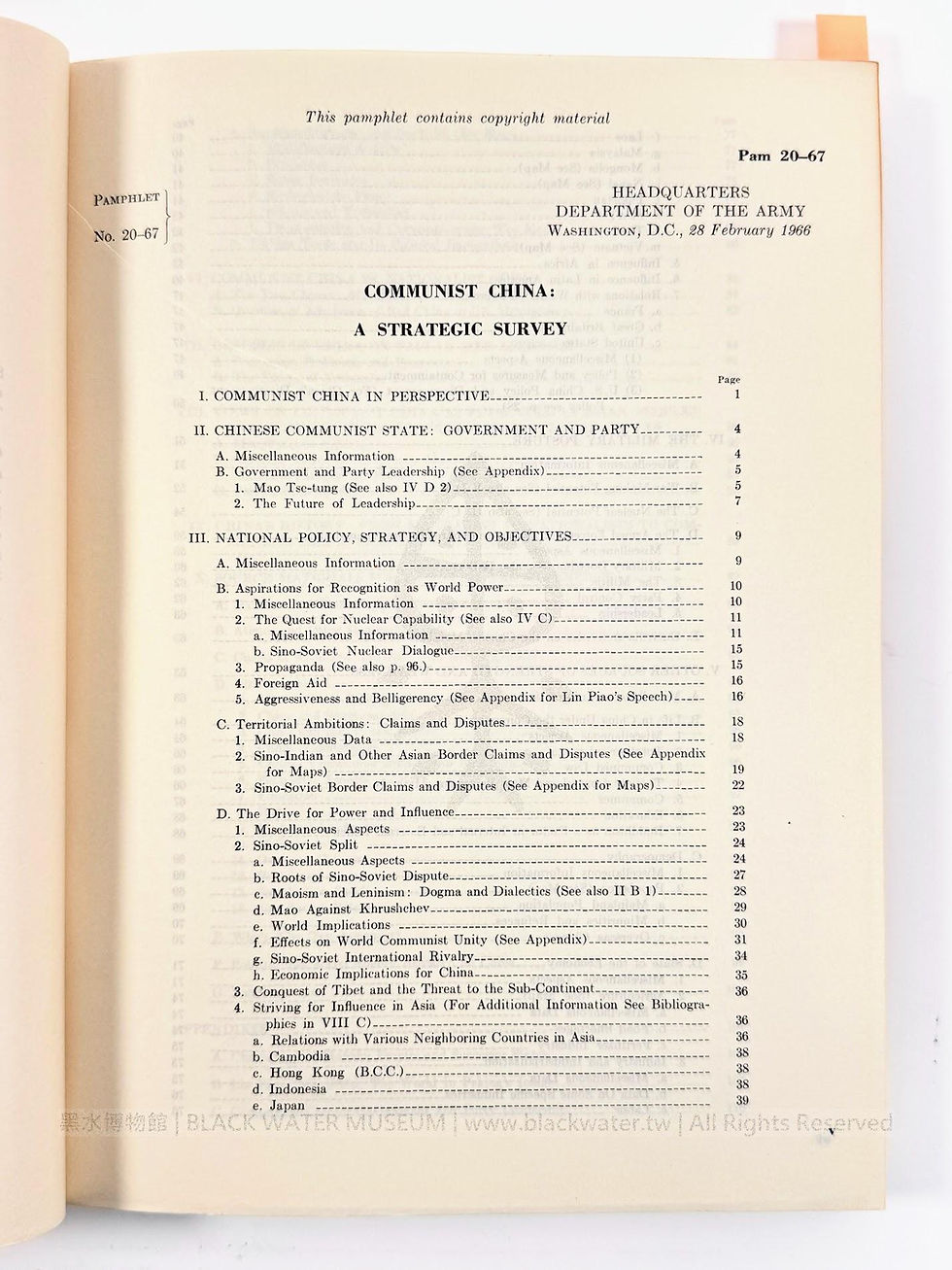
DA PAM 20-67 目錄 (Table of Contents)
英文標題 (English) | 正體中文翻譯 (Traditional Chinese) | 頁碼 |
I. COMMUNIST CHINA IN PERSPECTIVE | I. 透視共產中國 | 1 |
II. CHINESE COMMUNIST STATE: GOVERNMENT AND PARTY | II. 中共國家體制:政府與黨 | 4 |
A. Miscellaneous Information | A. 綜合資料 | 4 |
B. Government and Party Leadership (See Appendix) | B. 政府與黨的領導階層 (見附錄) | 5 |
1. Mao Tse-tung (See also IV D 2) | 1. 毛澤東 (另見 IV D 2) | 5 |
2. The Future of Leadership | 2. 領導權的未來 | 7 |
III. NATIONAL POLICY, STRATEGY, AND OBJECTIVES | III. 國家政策、戰略與目標 | 9 |
A. Miscellaneous Information | A. 綜合資料 | 9 |
B. Aspirations for Recognition as World Power | B. 尋求世界大國地位的渴望 | 10 |
1. Miscellaneous Information | 1. 綜合資料 | 10 |
2. The Quest for Nuclear Capability (See also IV C) | 2. 對核能力的追求 (另見 IV C) | 11 |
a. Miscellaneous Information | a. 綜合資料 | 11 |
b. Sino-Soviet Nuclear Dialogue | b. 中蘇核武對話 | 15 |
3. Propaganda (See also p. 96) | 3. 宣傳 (另見第 96 頁) | 15 |
4. Foreign Aid | 4. 對外援助 | 16 |
5. Aggressiveness and Belligerency (See Appendix for Lin Piao's Speech) | 5. 侵略性與好戰性 (見附錄中林彪的演說) | 16 |
C. Territorial Ambitions: Claims and Disputes | C. 領土野心:主張與爭端 | 18 |
1. Miscellaneous Data | 1. 綜合數據 | 18 |
2. Sino-Indian and Other Asian Border Claims and Disputes (See Appendix for Maps) | 2. 中印及其他亞洲邊境主張與爭端 (見附錄地圖) | 19 |
3. Sino-Soviet Border Claims and Disputes (See Appendix for Maps) | 3. 中蘇邊境主張與爭端 (見附錄地圖) | 22 |
D. The Drive for Power and Influence | D. 對權力與影響力的驅動 | 23 |
1. Miscellaneous Aspects | 1. 綜合層面 | 23 |
2. Sino-Soviet Split | 2. 中蘇決裂 | 24 |
a. Miscellaneous Aspects | a. 綜合層面 | 24 |
b. Roots of Sino-Soviet Dispute | b. 中蘇爭端的根源 | 27 |
c. Maoism and Leninism: Dogma and Dialectics (See also II B 1) | c. 毛主義與列寧主義:教條與辯證法 (另見 II B 1) | 28 |
d. Mao Against Khrushchev | d. 毛澤東對抗赫魯雪夫 | 29 |
e. World Implications | e. 世界性影響 | 30 |
f. Effects on World Communist Unity (See Appendix) | f. 對世界共產主義團結的影響 (見附錄) | 31 |
g. Sino-Soviet International Rivalry | g. 中蘇國際競爭 | 34 |
h. Economic Implications for China | h. 對中國的經濟影響 | 35 |
3. Conquest of Tibet and the Threat to the Sub-Continent | 3. 征服西藏與對次大陸的威脅 | 36 |
4. Striving for Influence in Asia (For Additional Information See Bibliographies in VIII C) | 4. 爭取在亞洲的影響力 (更多資訊見 VIII C 的書目) | 36 |
a. Relations with Various Neighboring Countries in Asia | a. 與亞洲各鄰國的關係 | 36 |
b. Cambodia | b. 柬埔寨 | 38 |
c. Hong Kong (B.C.C.) | c. 香港 (英屬殖民地) | 38 |
d. Indonesia | d. 印尼 | 38 |
e. Japan | e. 日本 | 39 |

英文標題 (English) | 正體中文翻譯 (Traditional Chinese) | 頁碼 |
f. Laos | f. 寮國 | 40 |
g. Malaysia | g. 馬來西亞 | 40 |
h. Mongolia (See Map) | h. 蒙古 (見地圖) | 41 |
i. Nepal (See Map) | i. 尼泊爾 (見地圖) | 41 |
j. Pakistan | j. 巴基斯坦 | 41 |
k. SEATO | k. 東南亞公約組織 (SEATO) | 42 |
l. Thailand | l. 泰國 | 42 |
m. Vietnam (See Map) | m. 越南 (見地圖) | 42 |
5. Influence in Africa | 5. 在非洲的影響力 | 43 |
6. Influence in Latin America | 6. 在拉丁美洲的影響力 | 43 |
7. Relations with Western Powers | 7. 與西方強權的關係 | 46 |
a. France | a. 法國 | 47 |
b. Great Britain | b. 英國 | 47 |
c. United States | c. 美國 | 47 |
(1) Miscellaneous Aspects | (1) 綜合層面 | 47 |
(2) Policy and Measures for Containment | (2) 圍堵政策與措施 | 47 |
(3) U.S. China Policy and Disarmament (For China's Disarmament Policy see p. 28) | (3) 美國對華政策與裁軍 (中共裁軍政策見第 28 頁) | 49 |
IV. THE MILITARY POSTURE | IV. 軍事態勢 | 51 |
A. Miscellaneous Information | A. 綜合資料 | 51 |
B. War-Making Potential (See also V D 4) | B. 戰爭潛力 (另見 V D 4) | 52 |
C. The Nuclear Potential (See also III C) | C. 核潛力 (另見 III C) | 54 |
D. The Armed Forces (For Estimate of Strength see Appendix) | D. 武裝部隊 (兵力估計見附錄) | 59 |
1. Miscellaneous Aspects | 1. 綜合層面 | 59 |
2. Military Doctrine (See also II B 1) | 2. 軍事準則 (另見 II B 1) | 60 |
3. The Militia | 3. 民兵 | 62 |
4. Party Control | 4. 黨的控制 | 62 |
5. Leadership | 5. 領導階層 | 63 |
E. Guerrilla Activities on the Chinese Mainland | E. 中國大陸上的游擊活動 | 63 |
V. OTHER SOURCES OF STRENGTH AND WEAKNESS | V. 其他強項與弱點來源 | 63 |
A. Miscellaneous Information | A. 綜合資料 | 63 |
B. Life in China Under the Communists | B. 共產黨統治下的中國生活 | 64 |
1. Miscellaneous Aspects | 1. 綜合層面 | 64 |
2. Totalitarianism | 2. 極權主義 | 66 |
3. Communist Law | 3. 共產主義法律 | 66 |
4. Thought Control and Mass Persuasion Methods | 4. 思想控制與群眾說服手段 | 66 |
5. Communes | 5. 人民公社 | 67 |
6. Education | 6. 教育 | 68 |
7. Buddhism as a Factor in Internal and External Policies | 7. 佛教作為對內對外政策的因素 | 68 |
C. Demography | C. 人口統計 | 69 |
1. Miscellaneous Information | 1. 綜合資料 | 69 |
2. Population (See Map) | 2. 人口 (見地圖) | 69 |
a. Mainland Population | a. 大陸人口 | 69 |
b. Minorities and Refugees | b. 少數民族與難民 | 70 |
c. Overseas Chinese | c. 海外華人 | 70 |
D. State of the Economy | D. 經濟狀況 | 71 |
1. Miscellaneous Aspects | 1. 綜合層面 | 71 |
2. Agriculture (See Map) | 2. 農業 (見地圖) | 74 |
a. Miscellaneous Data | a. 綜合數據 | 74 |
b. Food Shortages | b. 糧食短缺 | 75 |
c. Fertilizer Industry | c. 肥料工業 | 75 |
3. Industry and Industrialization | 3. 工業與工業化 | 75 |
a. Miscellaneous Data | a. 綜合數據 | 75 |
b. Data On Some Specific Industries | b. 特定工業數據 | 76 |
c. Labor | c. 勞工 | 76 |

英文標題 (English) | 正體中文翻譯 (Traditional Chinese) | 頁碼 |
4. Strategic Resources and Facilities (See Map) | 4. 戰略資源與設施 (見地圖) | 77 |
a. Miscellaneous Aspects | a. 綜合層面 | 77 |
b. Petroleum | b. 石油 | 77 |
c. Water Resources | c. 水資源 | 78 |
d. Hydroelectric Power | d. 水力發電 | 78 |
e. Science and Technology | e. 科學與技術 | 79 |
f. Transportation and Communications (See Maps) | f. 運輸與通訊 (見地圖) | 79 |
5. Foreign Trade and Its Political Implications | 5. 對外貿易及其政治意涵 | 80 |
VI. COMMUNIST CHINA VS. NATIONALIST CHINA | VI. 共產中國 對 中華民國 (國府) | 81 |
A. The Two Chinas: Miscellaneous Information | A. 兩個中國:綜合資料 | 81 |
B. Question of Admission of Red China to UN Membership | B. 紅色中國加入聯合國會籍之問題 | 82 |
VII. REPUBLIC OF CHINA ON TAIWAN (SEE APPENDIX) | VII. 中華民國在台灣 (見附錄) | 84 |
A. Prosperity, Problems, and Prospects | A. 繁榮、問題與展望 | 84 |
B. The Future of Nationalist Leadership | B. 國府領導階層的未來 | 86 |
VIII. VIEWS ON COMMUNIST CHINA AS PRESENTED IN ASIAN PEOPLES' ANTI-COMMUNIST LEAGUE PUBLICATIONS (TAIPEI, TAIWAN) | VIII. 亞洲人民反共聯盟出版物中對共產中國的看法 (台灣台北) | 86 |
A. Miscellaneous Aspects | A. 綜合層面 | 86 |
B. Guerrilla Activities on Chinese Mainland | B. 中國大陸上的游擊活動 | 88 |
C. Mainland Failures and Problems in Agriculture and Industry | C. 大陸工農業的失敗與問題 | 88 |
D. Peiping-Moscow Relations | D. 北平-莫斯科關係 | 88 |
IX. CHINA'S HISTORY: FROM MANDARINS TO NATIONALISTS TO COMMUNISTS (SEE APPENDIX) | IX. 中國歷史:從士大夫到國府再到中共 (見附錄) | 89 |
X. SOURCE MATERIALS FOR RESEARCH AND REFERENCE | X. 研究與參考用原始資料 | 92 |
A. Handbook of Chinese Communist Statements | A. 中共聲明手冊 | 92 |
B. Atlases and Other Geographic Aids | B. 地圖集與其他地理輔助工具 | 92 |
C. Charts of Mainland Activities (See also Appendix) | C. 大陸活動圖表 (另見附錄) | 94 |
D. Bibliographies | D. 書目 | 94 |
1. Miscellaneous Bibliographies | 1. 綜合書目 | 94 |
2. China and Southeast Asia | 2. 中國與東南亞 | 95 |
3. China and the Atomic Bomb | 3. 中國與原子彈 | 96 |
4. China—Communism | 4. 中國—共產主義 | 96 |
5. Chinese Communist Influence in Indonesia | 5. 中共在印尼的影響力 | 96 |
6. Economic Aspects | 6. 經濟層面 | 97 |
7. Education | 7. 教育 | 97 |
8. History | 8. 歷史 | 97 |
9. Mao and Leadership | 9. 毛澤東與領導階層 | 98 |
10. Military Aspects | 10. 軍事層面 | 98 |
11. Overseas Chinese | 11. 海外華人 | 98 |
12. Petroleum | 12. 石油 | 98 |
13. Sino-Indian Conflict | 13. 中印衝突 | 98 |
14. Sino-Soviet Relations | 14. 中蘇關係 | 99 |
E. Who's Who (See Appendix) | E. 名人錄 (見附錄) | 99 |
F. Political and Social Science Research on China | F. 關於中國的政治與社會科學研究 | 99 |
G. Language Aids | G. 語言輔助工具 | 100 |
APPENDIXES | 附錄 | 101 |
A. Chronology of Manchu Empire and Successor States | A. 滿清帝國及其繼承國編年史 | 103 |
B. Lin Piao's Manifesto; The World In Peking's Image | B. 林彪宣言;北京眼中的世界 | 107 |
C. Communist China's Government and Party Leadership | C. 中共政府與黨的領導階層 | 115 |

英文標題 (English) | 正體中文翻譯 (Traditional Chinese) | 頁碼 |
D. Checklist of Communist Party Positions in the Sino-Soviet Dispute, January 1965 | D. 各國共產黨在中蘇爭端中之立場一覽表,民國 54 年 (1965年) 1 月 | 121 |
E. List of Chinese Communist Weapons Captured in South Vietnam | E. 在南越俘獲的中共武器清單 | 125 |
F. Military Posture of Communist China and Its Allies | F. 共產中國及其盟友的軍事態勢 | 129 |
G. Nationalist Armed Forces on Taiwan | G. 在臺灣的國軍部隊 | 135 |
H. Maps | H. 地圖 | 139 |
(Inside back cover) | (封底內頁) | |
1. Northwest China-U.S.S.R. Boundary Area—Orientation Map | 1. 中國西北-蘇聯邊界地區—定位圖 | |
2. Northwest China-U.S.S.R. Boundary Area—Treaty Applications | 2. 中國西北-蘇聯邊界地區—條約適用範圍 | |
3. Sino-Mongolian Border, December 1962 | 3. 中蒙邊界,民國 51 年 (1962年) 12 月 | |
4. China-Nepal Boundary | 4. 中尼邊界 | |
5. Western Sino-Indian Border Area and Eastern China-India Frontier Area | 5. 中印邊界西段地區與中印邊界東段地區 | |
6. China-Vietnam Boundary | 6. 中越邊界 | |
7. Communist China—Population and Administrative Divisions | 7. 共產中國—人口與行政區劃 | |
8. Communist China—Selected Resources Sites | 8. 共產中國—選定資源產地 | |
9. Communist China—Principal Transportation Routes | 9. 共產中國—主要運輸路線 | |
10. Communist China—Highways—1960 | 10. 共產中國—公路—民國 49 年 (1960年) | |
11. Communist China—Population of Urban Areas—1960 | 11. 共產中國—市區人口—民國 49 年 (1960年) | |
I. Charts | I. 圖表 | 141 |
(Inside back cover) | (封底內頁) | |
1. Chinese Communist Military Organization | 1. 中共軍事組織 | |
2. Chinese Communist Government Organization | 2. 中共政府組織 | |
3. Chinese Communist Party Organization | 3. 中國共產黨組織 | |
4. Chinese Nationalist Government | 4. 中華民國政府 | |
5. Kuomintang | 5. 中國國民黨 |

COMMUNIST CHINA: A STRATEGIC SURVEY
I. COMMUNIST CHINA IN PERSPECTIVE
CHINA: DEVELOPMENT BY FORCE, by Perry P. Chang. Chicago, Curriculum Resources, Inc., 1964. 80 p. Contents: The historical background; early economic development of Communist China; the "great leap forward" and its aftermath; Nationalist China (Taiwan); Communist China and the world economy (importance of foreign trade; the Sino-Soviet dispute; China and India—a comparison; United States interests). Concludes: "China is still in a state of flux. Whether Communism can deliver her from poverty and suffering to a world economic power with all that this would imply, is one of the crucial questions facing all mankind."
CHINA 1964, in Far Eastern Economic Review, Hong Kong, v.46, no.1 (1 October 1964) 19-38. This annual survey of Communist China made by the editor of the Far Eastern Economic Review includes discussions on: New Confidence; Social Affairs; Industry; Agriculture; Foreign Trade; Foreign Relations (A Third Bloc?, The Sino-Soviet Dispute, Japan, Pakistan, Hong Kong, Malaysia, Indonesia, Burma, Ceylon, Nepal).
CHINA (PEOPLES' REPUBLIC, KNR). Kitai (Kitaiskaia Narodnaia Respublika), in Ezhegodnik [Annual] Bol'shoi Sovetskoi Entsiklopedii, 1965. Gosudarstvennoe Nauchnoe Izdatel'-stvo "Sovetskaia Entsiklopediia" 3 June 1965. pp. 282-285. In Russian. General description, Government organization, political parties, trade unions, economy, the most important events of 1964, and foreign policy of Communist China, as the Soviets see it.
CHINA'S POLITICS IN PERSPECTIVE, by Harold S. Quigley. Minneapolis, The University of Minnesota Press, 1962. 266 p. "A concise introduction to Chinese politics and policies. . . . It also seeks to contribute to an understanding of present-day China by recalling briefly her background of political ideas and the development of imperial and republican government." With recommended readings.
COMMUNIST CHINA—CONTINUING REVOLUTION, by A. Doak Barnett. New York, Foreign Policy Association, 1962. 580. (Headline Series number 153.) "The continuing Communist revolution in mainland China has, since 1949, transformed the lives and environment of more than a fifth of the world's peoples. The effects of this erratic and tumultuous upheaval reach far beyond China's borders, upsetting the so-called monolithic unity of the Communist bloc, threatening the independence of neighboring non-Communist states and challenging United States interests and aims throughout the world." In this study, the author explores the content, direction, and implications of the Chinese Communist revolution. Partial contents: Struggle for Modernization; Party and People; Economic Programs; Foreign Policy; etc.
COMMUNIST CHINA 1961. VOLUMES I AND II. Hong Kong, Union Research Institute, 1962. 2 v. (Communist China Problem Research Series.) This is the seventh in a series of annual volumes covering events in Communist China (however, in 1959 Union Research Institute prepared a special ten-year report entitled Communist China, 1949-1959). Volume I: The Party; Nationalities Affairs; Chinese Communist Youth League Affairs and Youth Movements; Cultural Activities in Communist China; Finance; The Labor Movement; Foreign Trade; Domestic Trade; Scientific Work. Volume II: Politics; Foreign Relations; Agriculture; Communications; Military Affairs; Overseas Chinese Affairs; Natural Calamities in Communist China; Education; Industry.
[COMMUNIST CHINA, 1965], in Current History, v.49, no.289 (September 1965) 129-181. A seven-article analysis pointing up the progress being made in Communist China and the problems facing China's aging leaders. Contents: Leadership and Succession in Communist China;
共產中國:戰略概覽
I. 透視共產中國
《中國:武力發展》 (CHINA: DEVELOPMENT BY FORCE),作者 Perry P. Chang。芝加哥,Curriculum Resources, Inc. 出版,民國 53 年 (1964年)。80 頁。 內容:歷史背景;共產中國早期的經濟發展;「大躍進」及其後果;中華民國 (台灣);共產中國與世界經濟 (對外貿易的重要性;中蘇爭端;中國與印度—比較;美國利益)。結論:「中國仍處於變動狀態。共產主義是否能將她從貧困和苦難中解救出來,成為一個具有一切意涵的世界經濟強權,是全人類面臨的關鍵問題之一。」
《中國 1964》 (CHINA 1964),載於《遠東經濟評論》(Far Eastern Economic Review),香港,第 46 卷,第 1 期 (民國 53 年/1964年 10 月 1 日),頁 19-38。 這份由《遠東經濟評論》編輯所作的共產中國年度調查,內容討論包括:新的信心;社會事務;工業;農業;對外貿易;對外關係 (第三集團?中蘇爭端、日本、巴基斯坦、香港、馬來西亞、印尼、緬甸、錫蘭、尼泊爾)。
《中國 (人民共和國,KNR)》 (CHINA (PEOPLES' REPUBLIC, KNR))。Kitai (Kitaiskaia Narodnaia Respublika),載於《蘇聯大百科全書年鑑 1965》(Ezhegodnik Bol'shoi Sovetskoi Entsiklopedii)。國立蘇聯百科全書科學出版社,民國 54 年 (1965年) 6 月 3 日。頁 282-285。俄文。 從蘇聯的角度,對共產中國的總體描述、政府組織、政黨、工會、經濟、1964 年最重要的事件以及外交政策。
《透視中國政治》 (CHINA'S POLITICS IN PERSPECTIVE),作者 Harold S. Quigley。明尼阿波利斯,明尼蘇達大學出版社,民國 51 年 (1962年)。266 頁。 「對中國政治與政策的簡明介紹……它也試圖透過簡要回顧其政治思想背景以及帝制與共和政府的發展,來幫助理解今日的中國。」附推薦讀物。
《共產中國—持續的革命》 (COMMUNIST CHINA—CONTINUING REVOLUTION),作者 A. Doak Barnett。紐約,外交政策協會 (Foreign Policy Association),民國 51 年 (1962年)。580 頁。(頭條叢書第 153 號)。 「自 1949 年以來,中國大陸持續不斷的共產革命已經改變了世界五分之一以上人口的生活和環境。這場反覆無常且動盪不安的劇變,其影響遠遠超出了中國的邊界,打亂了共產集團所謂鐵板一塊的團結,威脅著鄰近非共產國家的獨立,並挑戰了美國在世界各地的利益與目標。」在這項研究中,作者探討了中共革命的內容、方向和意涵。部分內容:現代化的鬥爭;黨與人民;經濟計畫;外交政策等。
《共產中國 1961,第一卷與第二卷》 (COMMUNIST CHINA 1961. VOLUMES I AND II)。香港,友聯研究所 (Union Research Institute),民國 51 年 (1962年)。2 冊。(共產中國問題研究系列)。 這是涵蓋共產中國事件的年度系列叢書中的第七本 (然而,友聯研究所在 1959 年編寫了一份特別的十年報告,題為《共產中國,1949-1959》)。第一卷:黨;民族事務;共青團事務與青年運動;共產中國的文化活動;財政;勞工運動;對外貿易;國內貿易;科學工作。第二卷:政治;對外關係;農業;通訊;軍事事務;僑務;共產中國的自然災害;教育;工業。
[共產中國,1965] ([COMMUNIST CHINA, 1965]),載於《當代歷史》(Current History),第 49 卷,第 289 期 (民國 54 年/1965年 9 月),頁 129-181。 一份包含七篇文章的分析,指出了共產中國正在取得的進展以及中國高齡領導人面臨的問題。內容:共產中國的領導權與繼承;

U.N. AGAIN REJECTS SOVIET PROPOSAL TO SEAT COMMUNIST CHINA, in The Department of State Bulletin, v.47, no.1221 (19 November 1962) 786-791. Statement by Adlai E. Stevenson, U.S. Representative to the General Assembly, made in plenary session on 22 October 1962, in which he touched on Communist China's "affinity for aggressive violence," loyalty of Republic of China to UN, the economic breakdown on the China Mainland, etc.
UNITED NATIONS RULES OUT CHANGE IN REPRESENTATION OF CHINA, in The Department of State Bulletin, v.46, no.1177 (15 January 1962) 108-117. Includes statements made in plenary by Ambassador Adlai E. Stevenson, U.S. Representative to the General Assembly, on the question of the representation of China in the United Nations, together with texts of a resolution adopted on December 15 and a Soviet draft resolution which was rejected.
THE U.S. AND CHINA: POLICY OR OBSESSION? in Newsweek, v.66, no.22 (29 November 1965) 44-46. An account of the latest vote in the UN on the admission of Red China. The significance of the closeness of the vote, the background to US policy toward China, reasons for present US position, Peking's potential, portents for the future, etc.
VII. REPUBLIC OF CHINA ON TAIWAN (SEE APPENDIX)
A. Prosperity, Problems, and Prospects
CHINA YEARBOOK 1964-65 (FORMERLY THE CHINA HANDBOOK). Taipei, Taiwan, China Publishing Co., 1965. 954 p. (18th ed.) The general period covered by the 18th edition is from July, 1963, through June, 1964. Some political, economic, social and cultural developments are reported up to the end of 1964. Partial contents: Flag of the Republic of China and National Anthem; Major Developments of the Year; General Information (History and Culture, Geographical Sketch, Population, Economic Resources, Religion and Philosophy, Political Parties, Taiwan Province, Kinmen and Matsu); Government and Its Functions; National Defense; International Affairs; National Economy; Social Affairs; Education and Culture; Chinese Communist Regime; Chronology; Who's Who, Maps, Charts, and Photographs.
DEMOGRAPHIC YEARBOOK, 1964. SIXTEENTH ISSUE. New York, United Nations, 1965. 752 p. Among the many tables are included statistics on the two Chinas for: population, natality, mortality, nuptiality, etc.
[FORMOSA], in The China Quarterly, No. 15 (July-September 1963) 3-114. A special survey including the following articles: Politics on Formosa, by John Israel; Some Aspects of Formosa's Economic Growth, by Sheppard Glass; Nationalist China's Armed Forces, Joyce K. Kallgren; Formosa's Diplomatic World, by Donald Klein; Dilemmas of America: Policy Towards Formosa, by Akira Iriye; Peking and Taipei, by Lewis Gilbert; The Intellectuals on Formosa, by Mei Wen-li; Literary Formosa, by Lucy H. Chen; Some Impressions of Formosa, by Jonathan Musky; The Development of Formosan Nationalism, by Maurice Meisner; and A Formosan's View of the Formosan Independence Movement, by Ong Joktik.
FORMOSA TODAY, ed. by Mark Mancall. New York, Praeger, 1964. 171 p. Contents: An outline of Formosan history; politics on Formosa; some aspects of Formosa's economic growth; Nationalist China's Armed Forces; Formosa's diplomatic world; dilemmas of American policy towards Formosa; Peking and Taipei (attitudes and relations with each other); the intellectuals on Formosa; literary Formosa; some impressions of Formosa; the development of Formosan nationalism; a Formosan's view of the Formosan independence movements.
LAWS OF THE REPUBLIC OF CHINA. Taipei, Taiwan, The Republic of China, 1961. 956 p. In English. Embraces 63 current laws and regulations of an economic and financial nature and consists of the following four parts: investment, land, internal revenue & customs duties, and labor. [See also elsewhere in this bibliography the laws of Communist China.]
LAWS OF THE REPUBLIC OF CHINA. Taipei, Taiwan, The Republic of China, 1961. 1470 p. (First Series—Major Laws.) In English. Deals among others, with law pertaining to: The Constitution of the Republic of China; Temporary Provisions effective During the Period of Communist Rebellion; National General Mobilization Law; The Civil Code and Its Related Laws; The Code of Civil Procedures and Its Related Laws;The Criminal Code and Its Related Laws (including Criminal Law of the Armed Forces); Administrative Laws; and National Defense and Military Affairs. [See also elsewhere in this bibliography the laws of Communist China.]
MCKAY'S GUIDE TO THE FAR EAST AND HAWAII, by Eleanor Cowles Gellhorn. New York, David McKay Co., 1965. 455 p. Includes a chapter on Taiwan.
PRESIDENT CHIANG KAI-SHEK'S SELECTED SPEECHES AND MESSAGES IN 1961. Taipei, Taiwan, Government Information Office, Republic of China, 1962? 103 p. Among the speeches: Remarks at the dinner in honor of the Vice President of the United States of America and Mrs. Lyndon B. Johnson, May 14, 1961; Message to the mass rally held in Taipei in support of the "Captive Nations Week" July 17, 1961; Answers to questions submitted by Takashi Oka, East Asia correspondent of the Christian Science Monitor, November 22, 1961; A Resume of the speech delivered at the Monthly Memorial Meeting for Dr. Sun Yat-sen, July 31, 1961; Interview with Mr. Oland D. Russell of Scripps-Howard Newspapers, December 6, 1961.
STUDIES ON ASIA, 1963, ed. by Robert K. Sakai. Lincoln, University of Nebraska Press, 1963. 196 p. Among the papers included: Dr. Sun Yat-sen and Chinese Secret Societies, by S. Y Teng, in which he defines the nature of these relations; and Taiwanese Nationalism: Problem for United States Policy, by David Wurfel, which is "a provocative study of Taiwanese nationalism with some pointed comments about United States policy for Taiwan."
THE REPUBLIC OF CHINA ON TAIWAN: A DESCRIPTIVE APPRAISAL, by Paul M.A. Linebarger, in World Affairs, v.126, no.1 (Spring 1963) 5-16. According to Mr. Linebarger, "The Republic of China . . . is one of the most interesting governments. Conceived in disaster, preserved by historical accidents, and now economically flourishing while politically misunderstood, this government has shown an unusual record of stability, reform and progress."
THE REPUBLIC OF CHINA: THE TAIWAN PERIOD, by Paul M.A. Linebarger, in World Affairs, v.127, no.4 (January-March 1965) 238-246. The Chinese Nationalists in Taiwan "never accept themselves as a Taiwanese nationality . . . they agree . . . with the Communists that there is only one China, but . . . they insist, in contrast to the Communists, that this one China can and shall be set within the framework of the Republic of China originally established January 1, 1912 and reestablished in 1928. It is the Republic of China as a historical and cultural continuity on which they base their claims to the future. Taiwan is therefore a key to China, and access to China. . ." The author mentions an interview held in February 1965 by Edgar Snow with Mao Tse-tung in which Mao pointed out "that the leadership of Communist China would after his own death and the death of his contemporaries pass to a new and untried generation of Communist leaders. Mao said that if these new leaders followed his own strict principles of rejecting coexistence, rejecting compromise with imperialism, rejecting the deviation of Khrushchev, Communist China could remain Communist. . . . [However] . . . if the Chinese Communist leaders of the next generation did not do this, imperialism . . . might prevail and the Chiang Kai-shek clique . . . could return to the Mainland." For Edgar Snow's story of the interview see New Republic (27 February 1965) 17-23.
THE TAIWAN ECONOMY, in Far Eastern Economic Review, Hong Kong, v.46, no.2 (8 October 1964) 75-102. An annual survey by the Review including discussions on: Towards a Self-Supporting Economy; The Rural Scene; Results of Land Reform; The Fertilizer Industry; The Textile Outlook; Petroleum and Gas; Automobiles; Plastic Prospects; Japan—Friends Again; Maylasia—Taiwan Invests; Thailand—Trade Stagnates; Hong Kong—One-Way Increase; and South Vietnam—Aided Trade.
TAIWAN IN CHINA'S FOREIGN RELATIONS 1836-1874, by Sophia Su-fei Yen. Hamden, Connecticut, Shoe String Press, 1965. 404 p. Attempts to describe and to analyze the role Taiwan played in China's foreign relations from 1836-1874. "This thirty-nine year period includes a significant transformation of China from an empire base on its traditional political universalism, in the direction of becoming a member of the 'family of nations' based on the concept of the limited state as defined in Western international law in mid-19th century." Part One: Taiwan Before The Treaty of Tientsin (Taiwan and the First Anglo-Chinese War;
〈聯合國再次否決蘇聯提議接納共產中國〉,載於《國務院公報》(The Department of State Bulletin),第 47 卷,第 1221 期 (民國 51 年/1962年 11 月 19 日),頁 786-791。 美國駐聯合國大會代表阿德萊·E·史蒂文森 (Adlai E. Stevenson) 於 1962 年 10 月 22 日全體會議上的聲明,其中觸及共產中國「對侵略暴力的偏好」、中華民國對聯合國的忠誠、中國大陸的經濟崩潰等議題。
〈聯合國排除改變中國代表權〉,載於《國務院公報》,第 46 卷,第 1177 期 (民國 51 年/1962年 1月 15 日),頁 108-117。 收錄美國駐聯合國大會代表阿德萊·E·史蒂文森大使在全體會議上關於聯合國中國代表權問題的聲明,以及 12 月 15 日通過的決議文和被否決的蘇聯決議草案。
〈美國與中國:政策還是執念?〉,載於《新聞週刊》(Newsweek),第 66 卷,第 22 期 (民國 54 年/1965年 11 月 29 日),頁 44-46。 關於聯合國最近對接納紅色中國投票的報導。包括票數接近的意義、美國對華政策的背景、美國目前立場的理由、北京的潛力、未來的預兆等。
VII. 中華民國在台灣 (見附錄)
A. 繁榮、問題與展望
《中華民國年鑑 1964-65》 (前身為《中國手冊》)。台灣台北,中國出版公司 (China Publishing Co.),民國 54 年 (1965年)。954 頁。(第 18 版)。 第 18 版涵蓋的主要時期為 1963 年 7 月至 1964 年 6 月。部分政治、經濟、社會和文化發展報導至 1964 年底。部分內容:中華民國國旗與國歌;年度大事記;概況 (歷史與文化、地理概略、人口、經濟資源、宗教與哲學、政黨、台灣省、金門與馬祖);政府及其職能;國防;國際事務;國家經濟;社會事務;教育與文化;中共政權;編年史;名人錄、地圖、圖表與照片。
《人口統計年鑑,1964。第十六期》。紐約,聯合國,民國 54 年 (1965年)。752 頁。 在眾多表格中,包含了關於兩個中國的統計數據:人口、出生率、死亡率、結婚率等。
[福爾摩沙],載於《中國季刊》(The China Quarterly),第 15 期 (民國 52 年/1963年 7月-9月),頁 3-114。 一份特別調查,包含以下文章:John Israel 撰〈福爾摩沙的政治〉;Sheppard Glass 撰〈福爾摩沙經濟成長的若干面向〉;Joyce K. Kallgren 撰〈中華民國武裝部隊 (國軍)〉;Donald Klein 撰〈福爾摩沙的外交世界〉;Akira Iriye 撰〈美國的兩難:對福爾摩沙的政策〉;Lewis Gilbert 撰〈北京與台北〉;Mei Wen-li 撰〈福爾摩沙的知識份子〉;Lucy H. Chen 撰〈文學的福爾摩沙〉;Jonathan Musky 撰〈福爾摩沙的一些印象〉;Maurice Meisner 撰〈福爾摩沙民族主義的發展〉;以及王育德 (Ong Joktik) 撰〈一個福爾摩沙人對福爾摩沙獨立運動的看法〉。
《今日福爾摩沙》,Mark Mancall 編。紐約,Praeger 出版社,民國 53 年 (1964年)。171 頁。 內容:福爾摩沙歷史大綱;福爾摩沙的政治;福爾摩沙經濟成長的若干面向;中華民國武裝部隊 (國軍);福爾摩沙的外交世界;美國對福爾摩沙政策的兩難;北京與台北 (彼此的態度與關係);福爾摩沙的知識份子;文學的福爾摩沙;福爾摩沙的一些印象;福爾摩沙民族主義的發展;一個福爾摩沙人對福爾摩沙獨立運動的看法。
《中華民國法律》。台灣台北,中華民國,民國 50 年 (1961年)。956 頁。英文版。 包含 63 項現行的經濟與財經性質的法律與法規,由以下四部分組成:投資、土地、稅務與關稅、以及勞工。[另見本書目中關於共產中國法律的部分。]
《中華民國法律》。台灣台北,中華民國,民國 50 年 (1961年)。1470 頁。(第一輯—主要法律)。英文版。 內容涉及:中華民國憲法;動員戡亂時期臨時條款;國家總動員法;民法及其相關法律;民事訴訟法及其相關法律;刑法及其相關法律 (包括陸海空軍刑法);行政法;以及國防與軍事事務。[另見本書目中關於共產中國法律的部分。]
《麥凱遠東與夏威夷指南》,作者 Eleanor Cowles Gellhorn。紐約,David McKay Co.,民國 54 年 (1965年)。455 頁。 包含關於台灣的一章。
《蔣中正總統 1961 年言論選集》。台灣台北,中華民國行政院新聞局,民國 51 年 (1962年)?103 頁。 演講內容包括:1961 年 5 月 14 日宴請美國副總統及其夫人詹森 (Lyndon B. Johnson) 晚宴上的致詞;1961 年 7 月 17 日致台北支援「被奴役國家週」群眾大會的訊息;1961 年 11 月 22 日答覆《基督教科學箴言報》東亞特派員 Takashi Oka 提問;1961 年 7 月 31 日在國父紀念月會上的演講摘要;1961 年 12 月 6 日接受斯克里普斯-霍華德報系 (Scripps-Howard Newspapers) Oland D. Russell 先生的訪問。
《亞洲研究,1963》,Robert K. Sakai 編。林肯市,內布拉斯加大學出版社,民國 52 年 (1963年)。196 p. 收錄論文包括:S. Y. Teng 撰〈國父孫中山與中國秘密會社〉,界定了這些關係的性質;以及 David Wurfel 撰〈台灣民族主義:美國政策的問題〉,這是一項「對台灣民族主義的挑釁性研究,並對美國對台政策提出了一些尖銳的評論。」
《中華民國在台灣:描述性評價》,作者 Paul M.A. Linebarger,載於《世界事務》(World Affairs),第 126 卷,第 1 期 (民國 52 年/1963年 春季號),頁 5-16。 根據 Linebarger 先生的說法,「中華民國……是最有趣的政府之一。它在災難中構思,因歷史的偶然得以保存,如今經濟繁榮但政治上被誤解,這個政府展現了非凡的穩定、改革與進步紀錄。」
《中華民國:台灣時期》,作者 Paul M.A. Linebarger,載於《世界事務》,第 127 卷,第 4 期 (民國 54 年/1965年 1月-3月),頁 238-246。 在台灣的中華民國政府人士「從不接受自己是台灣國籍……他們同意……共產黨人的觀點,即只有一個中國,但是……與共產黨人相反,他們堅持這一個中國可以且必須建立在最初於 1912 年 1 月 1 日成立並於 1928 年重建的中華民國架構之內。正是基於中華民國作為歷史與文化的延續性,他們建立了對未來的宣稱。因此,台灣是通往中國的關鍵,也是進入中國的途徑……」作者提到了 1965 年 2 月艾德加·斯諾 (Edgar Snow) 與毛澤東的訪談,毛在訪談中指出「共產中國的領導權在他死後及同時代人死後,將傳給新一代未經考驗的共產黨領導人。毛說,如果這些新領導人遵循他拒絕共存、拒絕與帝國主義妥協、拒絕赫魯雪夫修正主義偏離的嚴格原則,共產中國就可以保持共產主義……[然而]……如果下一代中共領導人不這樣做,帝國主義……可能會佔上風,而蔣中正集團……可能會重返大陸。」關於艾德加·斯諾的訪談報導,見《新共和》(New Republic) (1965 年 2 月 27 日) 頁 17-23。
《台灣經濟》,載於《遠東經濟評論》,香港,第 46 卷,第 2 期 (民國 53 年/1964年 10 月 8 日),頁 75-102。 該評論的年度調查,討論內容包括:邁向自給自足的經濟;農村景象;土地改革的成果;肥料工業;紡織業前景;石油與天然氣;汽車;塑膠業前景;日本—重修舊好;馬來西亞—台灣投資;泰國—貿易停滯;香港—單向增長;以及南越—援助貿易。
《中國外交關係中的台灣 1836-1874》,作者 Sophia Su-fei Yen。康乃狄克州 Hamden,Shoe String Press 出版,民國 54 年 (1965年)。404 頁。 試圖描述與分析 1836-1874 年間台灣在中國外交關係中扮演的角色。「這三十九年期間包含了中國的重大轉變,從基於傳統政治普遍主義的帝國基礎,轉向基於 19 世紀中葉西方國際法定義的有限國家概念,成為『萬國家庭』的一員。」第一部:天津條約前的台灣 (台灣與第一次中英戰爭;

Anglo-American Rivalry in the Far East and Taiwan); Part Two: Taiwan and Its Open Ports (The Treaty of Tientsin [1858] and the Ports of Taiwan; The Consular Establishments of Taiwan); Part Three: The Problem of China's Sovereignty Over Taiwan (The Chinese Government and the Taiwan Shipwrecks; The Ryukyus, Taiwan and Japan; Japanese Plans and Actions toward Taiwan; Sino-Japanese Negotiations and the Settlement of Sovereignty Issue). Bibliography.
TAIWAN'S INVESTMENT CLIMATE, by John E. Metcalf, in Far Eastern Economic Review, Hong Kong, v.45, no.3 (16 July 1964) 120-122. "Taiwan ... is bustling with economic activity ... [due] partly to its own resources and partly to the encouragement it gives for overseas investors to participate in the island's development." The author begins here a two-part analysis of economic conditions in Taiwan.
B. The Future of Nationalist Leadership
SUCCESSION AND MYTH IN TAIWAN, by Mark Mancall, in Journal of International Affairs, v.18, no.1 (1964) 12-21. "Generalissimo Chiang Kai-shek, 75, and now serving his third consecutive term as President of the Republic of China, presents a public image of health and vigor. But his capital, Taipei is rife with rumors of illness. ... True or not, the rumors, combined with the Generalissimo's advanced age, have made the subject of choosing his successor the main topic of political conversation in 'Free' China during the last few years. ... Whoever succeeds to the Generalissimo's power ... will face the almost insurmountable problem of dismantling in some way the highly complex set of myths upon which the strength of the Kuomintang rests."
WORLD REVOLUTIONARY ELITES; STUDIES IN COERCIVE IDEOLOGICAL MOVEMENTS, ed. by Harold D. Lasswell and Daniel Lerner. Cambridge, The M.I.T. Press, Massachusetts Institute of Technology, 1965. 478 p. Chapter six: Kuomintang and Chinese Communist Elites, by Robert C. North with Ithiel de Sola Pool (The Collapse of the Imperial Elite, The Development of the Kuomintang Leadership, The Development of the Chinese Communist Party Leadership, The Social Characteristics of Chinese Party Elites, Developments Under the People's Government). Chapter seven: The Coercive Ideologists in Perspective, by Daniel Lerner (China and the Emerging Nations, etc.).
VIII. VIEWS ON COMMUNIST CHINA PRESENTED IN ASIAN PEOPLES' ANTI-COMMUNIST LEAGUE PUBLICATIONS (TAIPEI, TAIWAN)
A. Miscellaneous Aspects
AN ANALYSIS OF THE COMMUNIST "LEARNING FROM THE LIBERATION ARMY" MOVEMENT. Taipei, Taiwan, Asian Peoples' Anti-Communist League, Republic of China, 1964. 64 p. "Following their call for learning from the liberation army,' the Communists set out starting the movements of 'comparison, learning, overtaking and help.' In plain words, these movements actually mean 'to compare with the advanced, to learn from the advanced, to overtake the advanced, and to help the backward.' In the view of the Communists, the political work of the Communist army is regarded as 'advanced' experience. Therefore, they call upon all others to compare with the Communist army and find out the 'distance' that separate them from the Communist army. This is the so-called 'comparison.' After 'comparison,' it is learn from the advanced,' 'to overtake the advanced' and 'to help the backward'." Contents: Background of the Communist "Learning from the Liberation" Movement; To Solve Problems from the Learning from "Liberation Army"; Purposes of and Methods for Learning from the "Liberation Army"; Establishment of "Political Work Department"; Cause and Result of Strengthening Political Work; Discussion includes problems connected with change in the quality of the Communist army; effects of the Moscow-Peiping relationship on the Communist Army; effects of the Communist purge on the Armed Forces; effects of military drill on the Communist Army; effects of educational management on the Communist troops.
CHINA'S BITTER EXPERIENCES WITH THE COMMUNISTS. Taipei, Taiwan, Asian Peoples' Anti-Communist League, Republic of China, 1962. 105 p. The birth and growth of Chinese Communism and the First Peaceful Co-existence; agrarian revolution and guerrilla warfare; the Second Peaceful Co-existence and its aftermath; loss of the Chinese Mainland; China's example for the emerging nations of Asia and Africa.
CHINESE COMMUNISTS EXPLOITATION AND PERSECUTION OF THE INTELLIGENTSIA, by Ho Wen-hai. Taipei, Taiwan, Asian Peoples' Anti-Communist League, Republic of China, 1963. 60 p. Chinese Communist policy toward the intelligentsia and actions taken; factual accounts of Communist persecution of the intelligentsia; anti-Communist remarks of intellectuals; student movements in Peiping; a "small-scale Hungary-type uprising" in the Hanyang Middle School in Hupei (June 12, 1958).
THE MILITIA: A THORN IN THE PEIPING'S SIDE, by Hsiang Nai-kuang. Taipei, Taiwan, Asian Peoples' Anti-Communist League, Republic of China, 1963. 19 p. Shows that Chinese Communist control over the militia is slipping and that the Reds are worried over the "unreliable political quality" of the militiamen.
PROCEEDINGS: THE TENTH CONFERENCE OF THE ASIAN PEOPLES' ANTI-COMMUNIST LEAGUE TAIPEI, TAIWAN, REPUBLIC OF CHINA NOVEMBER 23-27, 1964. Taipei, Taiwan, Secretariat of the Tenth APACL Conference, 1965. 212 p. The Tenth Conference of APACL has been held from November 23 to November 27, 1964 at the Ambassador Hotel in Taipei. There were 136 participants from 47 countries and organizations attending the Conference. During the Conference, seven plenary sessions were held, and a total of 32 Resolutions have been adopted. This publication includes: List of participants, agenda, speeches, summary reports, records, declaration of the conference and the full text of the resolutions. Among the resolutions: Resolution Supporting Malaysia in its Resistance Against Indonesian Aggression; Resolution Opposing the Neutralization of Vietnam and Southeast Asia; Resolution Urging the Free Nations of Asia and Africa to Strengthen Their Anti-Communist Cooperation; Resolution Warning Against Communist Offer of Scholarships for African Students and Proposing More Free World Educational Assistance; Resolution Urging Support of Laos and Vietnam in Their Anti-Communist Struggle; Resolution on Guarding Against Chinese Communist Efforts to Divide the Free World by Means of Trade, Economic Aid, and Tourism; Resolution Urging All Anti-Communist Nations in Asia to Set up a Mutual Security Organisation; Resolution Supporting India in Resisting Chinese Communist Aggression; Resolution on Free World Counter-Measures to the Chinese Communist Nuclear Explosion; Resolution Opposing United Nations Seating of the Chinese Communist Regime; Resolution Urging Pakistan to Break with Peiping and Demonstrate Its Allegiance to the SEATO Alliance; Resolution Urging Free World Nations to Guard Against Chinese Communist Sale and Smuggling of Narcotics; Resolution Urging Intensification of the Struggle Against International Communism to Take Advantage of the Split Between Moscow and Peiping.
A STUDY OF THE CURRENT FOREIGN AND DOMESTIC POLICIES OF THE PUPPET PEIPING REGIME. Taipei, Taiwan, Asian Peoples' Anti-Communist League, 1962. 18 p. Domestic policies in the economic and in the political field; and foreign policy. Projects Communist China's policy for the future as follows: "To step up infiltration and subversive activities abroad: Asia, Africa, and Latin America will remain the Peiping's targets for expansion. In Asia, it will continue to work for better relations with Japan through the medium of trade; step up its aid to both the Laotian and Vietnamese Reds with the support of material supplies and manpower. It is ready to launch a large-scale war in Laos as well as in Vietnam but will try to avoid direct involvement so as to minimize the danger of global war and to avert any possibility of the anti-Communist revolution on the mainland counter-offensive by the Republic of China against the mainland. In Africa, it will continue to encourage bloody struggle against the West, manufacture disturbances so as to win over those nations that have already achieved independence and to Sovietize those nations in the struggle for national independence. In Latin America, with Cuba as its base, it will continue its infiltration and subversive activities. The general of Communist activities abroad, however, is intensification of anti-American movement. It tries to form a united front in the fight against the United States with the combined forces of three continents —Asia, Africa, and Latin America. And this united front will serve as a camouflage in its intrigue to Sovietize Asia, Africa, and Latin America."
WORLD REVOLUTION AND NATIONALISM, by Wan Yan-kang. Taipei, Taiwan, Asian Peoples' Anti-Communist League, 1962. 74 p. Contents: From Class Line to National Line; National Line in the Orient; National Line in China; National Line in Soviet Russia; National Line During World War II; The Present State of the National Line; The Split Between the National Line and the Communist Camp.
;第二部分:台灣及其通商口岸(1858 年《天津條約》與台灣口岸;台灣的領事機構);第三部分:中國對台灣的主權問題(清政府與台灣船難事件;琉球、台灣與日本;日本對台計畫與行動;中日談判與主權問題的解決)。附書目。
《台灣的投資環境》,約翰·E·梅特卡夫著,載於《遠東經濟評論》,香港,第 45 卷第 3 期(1964 年 7 月 16 日),第 120-122 頁。 「台灣……經濟活動蓬勃發展……部分歸功於其自身的資源,部分歸功於對海外投資者參與島內開發的鼓勵。」作者在此對台灣經濟狀況進行了兩部分分析。
乙、國府領導層的未來
《台灣的繼承與神話》,馬克·曼考爾著,載於《國際事務雜誌》,第 18 卷第 1 期(1964 年),第 12-21 頁。 「蔣中正委員長現年 75 歲,目前正連任中華民國第三任總統,展現出健康活力的公眾形象。但其首都台北卻充斥著患病的傳聞。……無論傳聞真實與否,加上委員長高齡,使得選擇繼任者的話題成為過去幾年『自由』中國的主要政治談話內容。……無論誰繼承委員長的權力……都將面臨一個幾乎無法逾越的問題,即如何以某種方式拆解支撐國民黨實力的那套高度複雜的神話。」
《世界革命菁英:強制性意識形態運動研究》,哈羅德·D·拉斯威爾與丹尼爾·勒納編。劍橋,麻省理工學院出版社,1965 年,478 頁。 第六章:國府與中共菁英,由羅伯特·C·諾斯與伊希爾·德·索拉·普爾合著(帝制菁英的崩潰、國府領導層的發展、中國共產黨領導層的發展、中國政黨菁英的社會特徵、人民政府下的發展)。第七章:透視強制性意識形態專家,由丹尼爾·勒納著。
八、亞洲人民反共聯盟(台灣台北)出版品中對中共的看法
甲、雜項方面
《中共「向解放軍學習」運動分析》。台北,台灣,中華民國政府亞洲人民反共聯盟,1964 年,64 頁。 「在號召『向解放軍學習』之後,中共開始發動『比、學、趕、幫』運動。……在中共看來,共軍的政治工作被視為『先進』經驗。因此,他們號召所有人與共軍相比,找出與共軍的『差距』……」內容:運動背景、解決學習問題、目的與方法、「政治部」的建立、加強政治工作的因果;討論包括共軍性質變化、蘇北平關係對共軍的影響、肅清運動對武裝部隊的影響、軍演及教育管理等。
《中國對共黨的慘痛經驗》。台北,台灣,中華民國政府亞洲人民反共聯盟,1962 年,105 頁。 中國共產主義的產生與第一次和平共處;土地革命與游擊戰;第二次和平共處及其後果;失去中國大陸;中國作為亞非新興國家的榜樣。
《中共對知識份子的剝削與迫害》,何文海著。台北,台灣,亞洲人民反共聯盟,中華民國政府,1963 年,60 頁。 中共對知識份子的政策及採取的行動;迫害事實記錄;知識份子的反共言論;北平的學生運動;1958 年 6 月 12 日湖北漢陽中學發生的「小型匈牙利式起義」。
《民兵:北平政權的眼中釘》,向乃光著。台北,台灣,中華民國政府亞洲人民反共聯盟,1963 年,19 頁。 指出中共對民兵的控制正在減弱,中共對民兵「政治素質不可靠」感到憂慮。
《第十屆亞洲人民反共聯盟會議紀錄(台北,1964 年 11 月 23-27 日)》。台北,台灣,第十屆亞盟會議秘書處,1965 年,212 頁。 會議於台北國賓大飯店舉行,來自 47 國及組織的 136 人出席。通過 32 項決議,包含:支持馬來西亞抵抗印尼侵略;反對越南及東南亞中立化;敦促亞非加強反共合作;警告非洲學生勿接受中共獎學金;支持寮國與越南反共鬥爭;防範中共利用貿易分裂自由世界;建立亞洲互助安全組織;支持印度抵抗中共侵略;對抗中共核爆之措施;反對聯合國給予中共政權席位;敦促巴基斯坦與北平斷交並效忠東南亞條約組織;防範中共走私毒品;利用莫斯科與北平分裂局勢強化鬥爭。
《傀儡北平政權當前內外政策之研究》。台北,台灣,亞洲人民反共聯盟,1962 年,18 頁。 對內政策與外交政策。預測未來方針:「加強海外滲透與顛覆:亞、非、拉美仍是北平擴張的目標。……隨時準備在寮國與越南發動大規模戰爭,但設法避免直接捲入以降低全球戰爭風險,並防範反共革命及中華民國政府反攻大陸。……在拉美以古巴為基地進行滲透。其總方針是強化反美運動,聯合三大洲力量組成反美統一戰線,作為其將亞非拉美蘇維埃化陰謀的掩護。」
《世界革命與民族主義》,萬仰康著。台北,台灣,亞洲人民反共聯盟,1962 年,74 頁。 內容:從階級路線到民族路線;東方、中國、蘇俄的民族路線;二戰期間的民族路線;現狀及民族路線與共產陣營的分裂。

B. Guerrilla Activities on Chinese Mainland ANTI-COMMUNIST ACTIVITIES ON THE CHINESE MAINLAND. Taipei, Taiwan, Asian Peoples' Anti-Communist League, Republic of China, 1965. 43 p. Contents: The First State of Armed Guerrilla Activities After the Fall of Chinese Mainland (those who stayed behind to fight Communists at the end of 1949); The Rise of Civilian Anti-Communist Guerrillas; Anti-Communist Activities in Tibet; Anti-Communist Guerrilla Activities Under New Circumstance (plans made by Nationalist China to exploit the various unpopular moves made by the Communists on the Mainland); Outlook of Anti-Communist Guerrilla Activities on the Chinese Mainland (the potential). Some photos.
C. Mainland Failures and Problems in Agriculture and Industry COMMUNIST INDUSTRY—ITS PROBLEMS AND DIFFICULTIES. Taipei, Taiwan, Asian People's Anti-Communist League, Republic of China, 1964. 71 p. Sees Chinese Communist attempts to industrialize Chinese Mainland as a failure and evaluates the reasons behind the failure. Includes a study of the following individual industries: steel and iron, coal and charcoal, non-ferrous metallic industry, petroleum industry, power industry, heavy machinery industry, farm machinery industry, machinery for communications, ship-building industry, aeronautical industry, atomic industry, cement industry, fertilizer industry, timber industry, and light industry.
CRISIS OF THE CHINESE COMMUNIST REGIME—AS SEEN FROM LIENCHIANG DOCUMENTS, by Li Tien Min. Taipei, Taiwan, Asian Peoples' Anti-Communist League, Republic of China, 1964. 42 p. "The Lienchiang Documents, seized by the Anti-Communist National Salvation Army of the Republic of China during a surprise attack at Lienchiang County of Fukien Province in March 1964, were the official documents for internal circulation within Chinese Communist organizations at all levels. These documents were of 42 different kinds, numbering more than 200,000 words. Among them were resolutions of the CCP Central Committee, directives of the CCP Fukien Provincial Committee and the CCP Lienchiang County Committee, reports of rural communes and production brigades, as well as statistical charts and circulars on the implementation of the socialist education movement and on the exposure of internal problems in various communes. . . . The information contained therein not only reflects the actual situation of rural communes of a year ago but also gives us a better understanding of what is going on in organizations of the lower echelons."
FAILURES OF MAO TSE-TUNG'S DICTATORSHIP 1949-1963, PARTS I AND II, by Hwang Tien-chien. Taipei, Taiwan, Asian Peoples' Anti-Communist League, Republic of China, 1963. 2 v. The chapters in Part I are: agricultural failure; industrial setback; financial bankruptcy; political deterioration. The chapters in Part II: internal strife; military demoralization; exodus of starving refugees; popular uprisings.
THE LASTING CRISIS ON MAINLAND CHINA IN 1964, by Hwang Tien-chien. Taipei, Taiwan, Asian Peoples' Anti-Communist League, Republic of China, 1965. 86 p. Agriculture, industry, commerce, finance, and trade, political activities, the Community Party, the Communist Army ("the 'modernization' of the Chinese Communist army which had been begun after the Korean War came to a sudden end with the cessation of the Russian aid"), external activities, Moscow-Peiping conflict.
D. Peiping-Moscow Relations CHINESE COMMUNIST EXPANSION AND RIVALRY WITH THE SOVIET UNION IN ASIA, AFRICA AND LATIN AMERICA. Taipei, Taiwan, Asian Peoples' Anti-Communist League, Republic of China, 1964. 69 p. The six chapters in this booklet deal with Chinese Communist strategy and intrigues for political, diplomatic, economic and cultural expansion in Asia, Africa, and Latin America, and their differences and conflicts with the Russians. With a forecast of what the Chinese Communists will do hereafter in Asia, Africa, and Latin America.
A GENERAL SURVEY OF MOSCOW-PEIPING RELATIONS. Taipei, Taiwan, Asian Peoples' Anti-Communist League, 1963. 56 p. The present contradictions between Soviet Union and Communist China are not new. Takes a look at when and why these contradictions started and the conclusions that can be derived from the fact that they still continue.
MOSCOW-PEIPING RELATIONS AND KHRUSHCHEV-MAO STRUGGLE, by Hwang Tien-chien. Taipei, Taiwan, Asian Peoples' Anti-Communist League, Republic of China, 1963. 78 p. Among the contents: Khrushchev's rise to power and his policy toward Mao; disputes arising from purge of Stalin; ideological dispute arising from recitation of Leninist dogma; Khrushchev's offensive and Mao's counter-attack.
[Page 89]
IX. CHINA'S HISTORY: FROM MANDARINS TO NATIONALISTS TO COMMUNISTS (SEE APPENDIX) AMERICAN AND CHINESE: A HISTORICAL ESSAY AND A BIBLIOGRAPHY, by Kwang-Ching Liu. Cambridge, Mass., Harvard University Press, 1963. 211 p. This volume is the outgrowth of an extensive survey of archival and published sources in the US relating to Chinese-American relations. In his introductory essay the author raises many questions and possibilities for research on this whole subject. Part I deals with the question of historical problems arising from the contacts between Americans and Chinese (traders and entrepreneurs; missionaries; Chinese who went to the United States). Part II includes lists of what is in the opinion of the author "little-known sources, all in Western languages and mostly of American authorship, which are germane to the study of American-Chinese relations": (1) nongovernmental manuscripts and archives in libraries or other depositories in the United States; (2) biographies, memoirs, and published letters of Americans concerned with China and of Chinese who went to the United States; (3) comparatively obscure periodicals and newspapers published by Americans, Chinese, or Europeans in America or in China; and (4) reference works especially useful to the study of the Chinese end of the American-Chinese relationship. Includes two tables showing fields of concentration by Chinese students who attended American colleges, number of students attending, name of the institution and number of degrees conferred.
THE ASIAN CENTURY: A HISTORY OF MODERN NATIONALISM IN ASIA, by Jan Romein. Berkeley, University of California Press, 1962. 448 p. Includes also the history of modern nationalism in China from about the year 1500 to 1960. With: chronological survey, bibliography, and index of persons and places.
CHINA AND THE WEST: 1858-1861. THE ORIGINS OF TSUNGLI YAMEN, by Masataka Banno. Cambridge, Mass., Harvard University Press, 1964. 367 p. (Harvard East Asian Series, 15.) "As a result of the Arrow War, the Tsungli Yamen or 'Office for General Administration' of China's foreign relations was established in Peking early in 1861 to be a central organ for foreign affairs and deal with the Western diplomats who now, for the first time in China's history, were to take up permanent residence in the capital. The establishment of the Yamen was a turning point in China's foreign relations. It made an institutional change in her conduct of foreign affairs, ending the traditional principle of inequality between the Chinese empire and all other states, which had been institutionalized in the tribute system." - "This book is a study of diplomatic institutions, ideas, and activities as they intervened between domestic politics and foreign affairs. China's climatic resistance to the West in the late 1850's and her final submission to force majeure in 1860 accompanied by an intricate interplay of domestic and foreign influences, which led to the establishment of the Tsungli Yamen. . . ." Contents: The Arrow War; Western Demands for Diplomatic Representation in Peking; The Arrow War: The Domestic Political Scene; The Conduct of Foreign Affairs Following the Tientsin Treaties; Sino-Russian Conduct in Peking (1859-1860); Developments Following the Peking Conventions; Establishment of Tsungli Yamen. Bibliography.
THE CHINESE VIEW OF THEIR PLACE IN THE WORLD, by C. P. Fitzgerald. London, Oxford University Press, 1964. 72 p. (Issued under the auspices of the Royal Institute of International Affairs.) Pre-T'ang China; the golden age of the T'ang Empire; and China and the Modern World. (The Chinese and Christianity; Western view of nineteenth-century China; intellectuals and Western culture; the impact of the Russian revolution; Chinese Communism; doctrinal claims; Chinese isolation; the dispute with Russia; motives for the dispute; the aims of foreign policy.) Concludes: "The Chinese view of the world has not fundamentally changed; it has been adjusted to take account of the modern world, but only so far as to permit China to occupy, still, the central place in the picture. To do this it was necessary to accept from the West a new doctrine to replace the inadequate Confucian teaching, which was too limited. After a long struggle China found that the doctrine which suited her was the one which the West had repudiated; and it may well be that this in itself was a reason for making Communism, the outcast of Western origin, welcome in China. It was more easily digestible, could be assimilated to Chinese ways without bringing with it the full force of the Western influences. What was not possible was for China to continue for long to acknowledge the debt, and accept the position of pupil. Mao Tse-tung had to "enrich the treasury of Marxist-Leninist thought," so that the contents of that treasury could become current coin in China; it was inevitable that Chinese Marxism should be found to be purer than that of Russia, that Mao should be hailed as the greater prophet, and that "some people" should be shown to be in error. There cannot be two suns in one sky.
乙、大陸游擊活動
《中國大陸的反共活動》
台北,台灣,中華民國政府亞洲人民反共聯盟,1965 年。
內容:大陸淪陷後第一階段武裝游擊活動(1949 年底留在後方對抗共黨者);平民反共游擊隊的興起;西藏的反共活動;新形勢下的反共游擊活動(國府為利用共黨在大陸採取的各種不得人心之舉而制定的計畫);大陸反共游擊活動的展望(潛力)。附部分照片。
丙、大陸農業與工業的失敗與問題
《共黨工業——其問題與困難》
台北,台灣,中華民國政府亞洲人民反共聯盟,1964 年。
視中共在大陸實現工業化的企圖為失敗,並評估失敗原因。包含以下個別工業之研究:鋼鐵、煤炭、有色金屬、石油、電力、重型機械、農機、通訊、造船、航空、原子能、水泥、化肥、木材及輕工業。
《從連江文件看中共政權的危機》,李天民著
台北,台灣,中華民國政府亞洲人民反共聯盟,1964 年。
「中華民國反共救國軍於 1964 年 3 月突襲福建省連江縣時俘獲的『連江文件』,是中共各級組織內部傳閱的正式文件。這些文件共 42 種,字數超過 20 萬字。其中包含中共中央的決議、中共福建省委與連江縣委的指示、農村公社與生產大隊的報告,以及關於推行社會主義教育運動和揭露各公社內部問題的統計圖表與通告……其中包含的資訊不僅反映了一年前農村公社的實際情況,也讓我們更好地了解基層組織的運作情況。」
《毛澤東獨裁統治的失敗 1949-1963,第一及第二部分》,黃天健著
台北,台灣,中華民國政府亞洲人民反共聯盟,1963 年。2 冊。
第一部分的章節包含:農業失敗、工業退步、財政破產、政治惡化。第二部分的章節包含:內鬥、軍隊士氣低落、飢餓難民外逃、群眾起義。
《1964 年中國大陸持續的危機》,黃天健著
台北,台灣,中華民國政府亞洲人民反共聯盟,1965 年。
涵蓋農業、工業、商業、財政與貿易、政治活動、共產黨、共軍(「韓戰後開始的共軍『現代化』隨著俄援停止而猝然終止」)、對外活動、蘇北平衝突。
丁、北平與莫斯科關係
《中共在亞、非及拉丁美洲的擴張與同蘇聯的競爭》
台北,台灣,中華民國政府亞洲人民反共聯盟,1964 年。
本手冊的六個章節探討了中共在亞、非、拉美進行政治、外交、經濟和文化擴張的策略與陰謀,以及他們與蘇聯的分歧和衝突。並預測了中共今後在亞、非、拉美的行動。
《蘇北平關係概覽》
台北,台灣,亞洲人民反共聯盟,1963 年。
蘇聯與中共當前的矛盾並非新事。本書探討了這些矛盾何時以及為何開始,並從矛盾持續的事實中得出結論。
《蘇北平關係與赫魯雪夫、毛澤東的鬥爭》,黃天健著
台北,台灣,中華民國政府亞洲人民反共聯盟,1963 年。
部分內容包含:赫魯雪夫的掌權及其對毛政策;因肅清史達林引發的爭端;因背誦列寧教條引發的意識形態爭論;赫魯雪夫的進攻與毛的反擊。
九、中國歷史:從士大夫到國府到共黨(見附錄)
《美國人與中國人:史論與書目》,劉廣京著
麻薩諸塞州劍橋,哈佛大學出版社,1963 年。
本書是對美國國內關於美中關係的檔案及出版資料進行廣泛調查的產物。第一部分討論美中接觸引發的歷史問題(商人與企業家、傳教士、赴美華人)。第二部分包含作者認為與美中關係研究密切相關的「鮮為人知的史料」清單,包括:(1) 美國圖書館或其他存放機構的非官方手稿與檔案;(2) 涉及中國的美國人以及赴美華人的傳記、回憶錄及出版書信;(3) 在美國或中國由美國人、中國人或歐洲人出版的較冷門期刊與報紙;(4) 對研究美中關係中中國方面特別有用的參考著作。
《亞洲世紀:亞洲現代民族主義史》,揚·羅梅著
柏克萊,加州大學出版社,1962 年。
亦包含約 1500 年至 1960 年的中國現代民族主義史。
《中國與西方:1858-1861。總理衙門的起源》,坂野正高著
麻薩諸塞州劍橋,哈佛大學出版社,1964 年。哈佛東亞系列,15。
「由於英法聯軍之役(Arrow War),中國處理外交事務的『總理各國事務衙門』於 1861 年初在北京成立,成為外交事務的中央機構……衙門的成立是中國外交關係的轉折點。它使中國在外交行為上發生了體制變革,結束了傳統上大清帝國與所有其他國家之間不平等的原則(該原則已制度化為朝貢體系)。」本書研究了在國內政治與外交事務之間介入的外交體制、思想與活動。
《中國人眼中的世界地位》,費子智著
倫敦,牛津大學出版社,1964 年。
涵蓋唐以前的中國、唐帝國的黃金時代以及中國與現代世界(包含中國人與基督教、十九世紀中國的西方視角、知識份子與西方文化、俄國革命的影響、中國共產主義等)。結論:「中國人的世界觀並未發生根本改變;它已進行調整以適應現代世界,但僅限於允許中國仍占據畫面的中心位置。」最適合她的,正是西方所摒棄的那一個(指共產主義);這本身或許就是中國歡迎共產主義——這個源自西方的『棄兒』——的原因。它更容易被吸收,能融入中國的方式而不必帶來西方的全面影響。中國不可能長期承認欠債並接受學生的地位。毛澤東必須『豐富馬列主義思想庫』,使其內容在中國流通;中國式馬克思主義必然被發現比蘇俄更純粹,毛被譽為更偉大的先知,而『某些人』則被證明犯了錯誤。天無二日。」

CONFLICT; THE HISTORY OF THE KOREAN WAR, 1950-53, by Robert Leckie. New York, G. P. Putnam's, 1962. 448 p. With information on Communist China's role in the Korean War and the operations of the Chinese People's Liberation Army. With maps including one showing how and where the Chinese Communists entered the war), bibliography, and appendices (estimated casualties of the Korean War—both UN Forces and Communist Forces; also the Armistice Agreement).
THE GREAT WALL OF CHINA, by Robert Silverberg. Philadelphia, Chilton Books, 1965. 232 p. The wall itself, the character of the man who built it, and the role it has played in Chinese history. The author states that "There was a China before Ch'in and walls in China before the Great Wall. We need perspective. To understand Ch'in Shih Huang Ti and his Wall, we must take the long view of China's four thousand years of recorded history."
[HISTORIOGRAPHY UNDER THE COMMUNISTS], in The China Quarterly, no. 23 (July-September 1965) 67-169. Consists of the following papers: Archaeology in Communist China, by Cheng Te-kun; Chinese Communist Treatment of the Origins and Foundation of the Chinese Empire, by A. F. P. Hulsewé; The Chinese Middle Ages in Communist Historiography, by C. P. Fitzgerald; The Reappraisal of Neo-Confucianism, by Hellmut Wilhelm; The December 9th Movement—A Case Study in Chinese Communist Historiography, by John Israel.
LETTER FROM NANKING, by Capt. Roy Huang, in Military Review, v. 45, no. 2 (February 1965) 69-77. A reprint of an article which appeared in the December 1948 issue of Military Review. The article was reprinted because of its historical value and because of the position which Communist China holds in the world today. It points out the total nature of the war that was fought on the China mainland between 1946 and 1948, the mental and physical toughness of the Communist soldier, the ruthlessness of his leaders, and some actions that might have been taken to combat more effectively the Communist takeover. The author, in 1948, saw action in Manchuria against the Chinese Communists, and his letter is dated at Nanking 3 June 1948.
M. N. ROY'S MISSION TO CHINA, by Robert C. North and Xenia J. Eudin. Berkeley, Calif., University of California Press, 1963. 399 p. The Communist-Kuomintang Split of 1927 supported by documents. ("Roy—a Hindu Brahmin by birth... rose rapidly within the Comintern hierarchy to become the most prominent Asian exponent and theoretician of Communism for Asia. . . . It is no exaggeration to state that Roy ranks with Lenin and Mao Tse-tung in the development of fundamental Communist policy for the underdeveloped, as contrasted with the industrialized, areas of the globe. . . . In 1927 the Communist International assigned Roy the task of trouble-shooting the alliance between the Kuomintang and the Chinese Communist Party, which was suffering increasingly disruptive stress. As it turned out, his failure to achieve a satisfactory solution made him a persona non grata—or more precisely perhaps a scapegoat—in the eyes of Stalin, and so it was that the China mission, which might have enhanced his already considerable prestige with the Comintern, actually brought about his political downfall.") Bibliography.
MORGENTHAU DIARY (CHINA). PREPARED BY THE SUBCOMMITTEE TO INVESTIGATE THE ADMINISTRATION OF THE INTERNAL SECURITY ACT AND OTHER INTERNAL SECURITY LAWS OF THE COMMITTEE ON THE JUDICIARY UNITED STATES SENATE, 89TH CONGRESS 1ST SESSION, FEBRUARY 5, 1965, VOLUMES I AND II. Washington, Government Printing Office, 1965. 2 v. (Committee Print.) The Subcommittee notes that "numerous documents used in this study were originally classified 'Secret,' 'Confidential,' or otherwise. All have been declassified by the Department of State for the subcommittee's use."
MOSCOW AND CHINESE COMMUNISTS, by Robert C. North. 2nd ed. Stanford, California, Stanford University Press, 1963. 310 p. This book seeks to outline the beginnings of the Chinese Communist movement, its relations with Moscow, the rise of Mao Tse-tung, the establishment of People's Republic of China, and the course of Sino-Soviet relations over the succeeding decades.
THE OPIUM WARS IN CHINA, by Edgar Holt. Chester Springs, Pa., Dufour Editions, 1964. 303 p. "Though the series of small wars which Britain, at first alone and later with France as her ally, waged in China at various times between 1839 and 1860 are referred to by Chinese writers as the Opium Wars, in the West it is more usual to call only the first of these wars an Opium War and to describe the later hostilities as the Arrow War and its aftermath or the second and third Anglo-Chinese wars. . . . The purpose of the present book is to describe the wars, the truces and the treaties from both Western and Chinese viewpoints, making use both of contemporary narratives and of later researches by Western scholars, and to show how the objective of opening the Chinese door was finally achieved."
THE REVOLUTION OF 1911: A GREAT DEMOCRATIC REVOLUTION OF CHINA, by Wu Yu-chang. Peking, Foreign Languages Press, 1962. 145 p. Chinese Communist version of the Revolution of 1911. The Peking Foreign Languages Press comments as follows: "October 10, 1961 marks the 50th anniversary of the Revolution of 1911. The present English edition has been prepared to commemorate this great Chinese revolution and give our foreign readers a better understanding of it."
STRATEGIC SURPRISE IN THE KOREAN WAR, by H. A. DeWeers. Santa Monica, Calif., Rand Corporation, 1962. 35 p. (P-1800-1.) "Three assumptions seem to have developed [in the US] after Pearl Harbor about intelligence problems relating to surprise attack. One is that if we collect everything, we will be reasonably sure not to miss key intelligence items. The second is that improved coordination between organizations and a wider sharing of intelligence data between individual units and organizations will help safeguard us against surprise. . . ."
STUDIES ON ASIA, 1963, ed. by Robert K. Sakai. Lincoln, University of Nebraska Press, 1963. 196 p. Among the papers included: Dr. Sun Yat-sen and Chinese Secret Societies, by S. Y. Teng; Taiwanese Nationalism: Problem for United States Policy, by David Wurfel.
TAIWAN IN CHINA'S FOREIGN RELATIONS 1836-1874, by Sophia Su-fei Yen. Hamden, Connecticut, Shoe String Press, 1965. 404 p.
《衝突:韓戰史 1950-53》,羅伯特·萊基著。紐約,1962 年,448 頁。 包含關於中共在韓戰中的角色及中國人民解放軍作戰的資訊。附地圖(包括顯示中共如何及從何處參戰的地圖)、書目及附錄(韓戰中聯合國軍與共軍的估計傷亡人數;以及停戰協定)。
《中國長城》,羅伯特·希爾弗伯格著。費城,1965 年,232 頁。 探討長城本身、築牆者的性格以及長城在中國歷史上的角色。作者指出:「秦代以前已有中國,長城以前中國已有城牆。我們需要透視感。要理解秦始皇帝及其長城,必須以中國四千年記載歷史的長遠眼光來看待。」
《[共黨統治下的史學研究]》,載於《中國季刊》,第 23 期(1965 年 7-9 月),第 67-169 頁。 由下列論文組成:中共統治下的考古學(鄭德坤著);中共對中國帝國起源與基礎的處理(何四維著);共黨史學中的中國中世紀(費子智著);對新儒學的重新評價(衛禮賢著);一二九運動——中共史學研究個案(以色列著)。
《南京來信》,黃上尉(Capt. Roy Huang)著,載於《軍事評論》,第 45 卷第 2 期(1965 年 2 月),第 69-77 頁。 轉載自 1948 年 12 月號《軍事評論》的一篇文章。轉載此文係因其歷史價值,以及中共在現今世界所佔的地位。文中指出 1946 年至 1948 年間在中國大陸進行的戰爭之全盤性質,共軍士兵的身心強韌,其領導人的殘酷,以及本可採取哪些行動以更有效應對共黨的奪權。作者於 1948 年在東北與中共作戰,其信件日期為 1948 年 6 月 3 日,發自南京。
《羅易的中國使命》,羅伯特·C·諾斯與謝妮亞·尤金著。柏克萊,加州大學出版社,1963 年,399 頁。 透過文件支持 1927 年的國共分裂研究。(「羅易——出身印度婆羅門……在共產國際階層中迅速崛起,成為亞洲共產主義最傑出的亞洲代表與理論家。……毫不誇張地說,羅易在為全球欠發達地區(相對於工業化地區)制定基本共產黨政策方面的地位,與列寧和毛澤東並列。……1927 年,共產國際委派羅易負責處理當時壓力日益增大的國民黨與中國共產黨聯盟。事實證明,他未能達成滿意的解決方案,使他成為史達林眼中的不受歡迎人物——或者更準確地說是替罪羔羊——因此,這場本可提升他在共產國際聲望的中國使命,實際上導致了他的政治垮台。」)附書目。
《摩根索日記(中國)。由美國參議院司法委員會內部安全法及其他內部安全法律管理調查小組委員會準備,第 89 屆國會第 1 次會議,1965 年 2 月 5 日,第一冊及第二冊。》 華盛頓,1965 年,2 冊。(委員會印刷品。) 小組委員會指出:「本研究使用的許多文件原列為『秘密』、『機密』或其他類別。現均已由國務院解密供小組委員會使用。」
《莫斯科與中共》,羅伯特·C·諾斯著。第二版,1963 年,310 頁。 本書旨在概述中國共產主義運動的開端、其與莫斯科的關係、毛澤東的崛起、中華人民共和國的成立,以及隨後數十年間蘇北平關係的歷程。
《中國的鴉片戰爭》,埃德加·霍爾特著。1964 年,303 頁。 「雖然英國(起初單獨,後來與法國結盟)在 1839 年至 1860 年間於中國進行的一系列小規模戰爭被中國作家稱為『鴉片戰爭』,但在西方,通常僅將其中第一次稱為鴉片戰爭,並將後來的敵對行動描述為『亞羅號戰爭』(英法聯軍之役)及其後果,或第二次及第三次英中戰爭。……本書旨在從西方與中國雙方的觀點描述戰爭、停戰及條約,同時利用當代的記述與後來西方學者的研究,並展示打開中國門戶的目標是如何最終達成的。」 (註:此處之「打開門戶」涉及與清政府的交涉)
《辛亥革命:中國偉大的民主革命》,吳玉章著。北平外文出版社,1962 年,145 頁。 辛亥革命的中共觀點版本。北平外文出版社評論如下:「1961 年 10 月 10 日標誌著辛亥革命五十週年。本英文版旨在紀念這場偉大的中國革命,並讓外國讀者更了解它。」
《韓戰中的戰略奇襲》,H. A. 德威爾斯著。蘭德公司,1962 年,35 頁。 「珍珠港事件後,美國似乎對有關奇襲的情報問題產生了三種假設。一是如果我們蒐集所有資訊,就能確信不會錯過關鍵情報項。二是加強組織間的協調,並在個人單位與組織間更廣泛地共享情報資料,將有助於防範奇襲。……」
《亞洲研究 1963》,坂井博編。1963 年,196 頁。 收錄論文包含:孫逸仙博士與中國秘密社會(鄧嗣禹著);台灣民族主義:美國政策的問題(大衛·沃費爾著)。
《1836-1874 年中國外交關係中的台灣》,嚴Sophia Su-fei著。1965 年,404 頁。

Attempts to describe and to analyze the role Taiwan played in China's foreign relations from 1836-1874. "This thirty-nine year period includes a significant transformation of China from an empire based on its traditional political universalism, in the direction of becoming a member of the 'family of nations' based on the concept of the limited state as defined in Western international law in mid-19th century." Part One: Taiwan Before The Treaty of Tientsin (Taiwan and the First Anglo-Chinese War; Anglo-American Rivalry in the Far East and Taiwan); Part Two: Taiwan and Its Open Ports (The Treaty of Tientsin [1858] and the Ports of Taiwan; The Consular Establishments of Taiwan); Part Three: The Problem of China's Sovereignty Over Taiwan (The Chinese Government and the Taiwan Shipwrecks; The Ryukyus, Taiwan and Japan; Japanese Plans and Actions toward Taiwan; Sino-Japanese Negotiations and the Settlement of Sovereignty Issue). Bibliography.
20TH CENTURY CHINA, by O. Edmund Clubb. New York, Columbia University Press, 1964. 470 p. The subject of twentieth century China extends from the imperial era, through the transitional Republican Period, and into the Communist stage of Chinese history. "This volume is a political history, a bird's-eye survey aimed at tracing the main course of developments that led to the final collapse of the dynastic principle, the abortive experiment in republicanism, and the final resort to a Sinicized Communism as the presumed solution for China's tremendous problems." Contents: "Confucian" China; Collapse of the Confucian Order; The Nationalist Interregnum; The Communist Era in China (The New Regime, Peking at the Crossroads, Shift in Peking's Foreign Policy, and Communist China Today). With time chart, and bibliographical note.
THE UNQUENCHABLE SPARK. Peking, Foreign Languages Press, 1963. 153 p. "The stories in this volume are selected and translated from the Fourth Volume of THE SPARK THAT STARTED A PRAIRIE FIRE, a collection of reminiscences of the Chinese revolution, published in June 1961 by the People's Literature Publishing House, Peking." Among the titles: Guerrillas in Southern Kiangsi; Thrice We Fooled the Enemy; Night Raid on Lungyen; The Ambush at Chinmu Ridge; Loyalty As Deep As the Sea; Fighting in Southwest Chekiang. With map showing guerrilla areas in the Southern provinces winter 1934—autumn 1937.
X. SOURCE MATERIALS FOR RESEARCH AND REFERENCE A. Handbook of Chinese Communist Statements CHINESE COMMUNIST WORLD OUTLOOK. A HANDBOOK OF CHINESE COMMUNIST STATEMENTS: THE PUBLIC RECORD OF A MILITANT IDEOLOGY. Washington, Department of State, Bureau of Intelligence and Research, 1962. 139 p. "This volume presents the chief motivating ideas and theories of the Chinese Communists in the words of the Chinese leaders themselves. It sets out under reference headings a selection of these leaders' statements which, taken together, give a representative view of the main themes of Chinese Communist ideology." Chinese history and society; revolutions and revolutionary strategy; the exercise of power; ideological deviations and ideological reform; colonialism and imperialism; party and government affairs; social problems and policies; economic problems and policies; religious policy; education and scientific research; cultural policy; ethnic minorities; military affairs; major campaigns and policy trends; basic principles of foreign policy; propaganda themes in foreign relations; views on war and peace; international organizations, conferences, and negotiations; views of the Soviet Union, the Communist Bloc, and the international Communist movement; attitude and policies toward the non-Communist world (Asia, Africa, and Latin America, India, Japan, United States); overseas Chinese; policy toward the Republic of China. With a list of principal individuals quoted and principal sources cited.
B. Atlases and Other Geographic Aids AN ATLAS OF WORLD AFFAIRS, by Andrew Boyd. New York, Frederick A. Praeger, 1964. 160 p. "This . . . reference book supplies basic information on . . . [many] aspects of contemporary world happenings. More than 70 newly-drawn maps focus on those regions of the world which are in the news. . . . The Atlas clarifies each country's vital resources, its finances, populations, alliances and political trends. . . . A text accompanies each map, explaining the background and summarizing the situation." Partial contents: People, Power, Oil, Some Key Minerals, Asia and Africa, Kashmir, Himalayan Borders, Communist Central Asia, [Page 93] Chinese in South-East Asia, Formosa and Quemoy, the Korean War, etc., China and India, China and Russia, etc.
[Page 93]
DEMOGRAPHIC YEARBOOK 1962. New York, United Nations, 1962. 665 p. Chapter I: notes on availability of national population census data and methods of evaluating their reliability; Chapter II: technical notes on the statistical tables. Tables present data, among others on: population, natality, nuptiality, international migration and travel.
DEMOGRAPHIC YEARBOOK, 1964: SIXTEENTH ISSUE. New York, United Nations, 1965. 752 p. Among the many tables are included statistics on the two Chinas for: population, natality, mortality, nuptiality, etc.
THE EUROPA YEAR BOOK 1964. VOLUME I: AFRICA, THE AMERICAS, ASIA, AUSTRALASIA. London, Europa Publications Limited, 1964. 1280 p. Chapters are devoted to People's Republic of China as well as Republic of China.
HAMMOND'S NEW SUPREME WORLD ATLAS. Garden City, N.Y., Doubleday & Co., 1962. 176 p. Partial contents: Gazetteer-Index of the World; Index of Principal Cities of the World; Political Maps of the World; Political Maps of Asia and Individual Countries (including China); etc.
McGRAW-HILL INTERNATIONAL ATLAS. New York, McGraw-Hill, 1963. Various paging. (Edition Kartographisches Institut Bertelsmann.) Table of contents, reference index, preface, key languages and names table, and geographical glossary are all in English, German, and French. "An internationally valid method of nomenclature" is introduced on the maps. The use of German equivalents is restricted mainly to the world and continental maps in the map series "The world." In the continental maps, however, the international, i.e., official spellings are always shown additionally. In the regional and national maps the international, i.e., official names have been used almost without exception, while in the case of place-names genuine German equivalents have been added to them.
NATIONAL GEOGRAPHIC ATLAS OF THE WORLD. Washington, National Geographic Society, 1963. 300 p. With color maps.
RAND McNALLY COMMERCIAL ATLAS AND MARKETING GUIDE, NINETY-SIXTH EDITION. New York, Rand McNally, 1965. Various paging. Among others includes maps on China. Also general world information, such as: air line distances; altitudes of selected cities; gazetteer index of countries, regions, and political divisions; world facts and comparisons; world physical comparisons; etc.
RAND McNALLY INTERNATIONAL ATLAS. New York, Rand McNally & Co., 1961. Various paging. Partial contents: The World and Special Regions (Polar Map of the World, The World, etc.); Eurasia (including Middle East); Physical World in Maps (including The World, Asia, etc.) Selected World Information Tables (Political Information, World Facts and Comparisons, Principal Lakes, Mountains, Islands, Rivers, Waterfalls, Cities and Populations, Historical Gazetteer, Principal Discoveries and Explorations, and World Air Distance and Steamship Distance Tables); etc.
RAND McNALLY COSMOPOLITAN WORLD ATLAS. Chicago, Rand McNally, 1962. 236 p. "In design, scope, and organization the Cosmopolitan World Atlas is quite different from any reference atlas previously published in the United States. The world has been mapped on a regional basis, not country by country; but each regional map is centered around a major country of a significant grouping of countries." The index includes in one alphabetical listing all the names that appear in the Atlas. Section of comparative world maps, pages 126-133 deals with: climates, natural vegetation, population, races, languages, religions; section of maps of the world through the ages, pages 134-160 includes among others the maps of: Alexander's empire; Asia at the death of Kublai Khan, 1294; Asia after World War II showing changes to 1950.
WORLD REGIONAL GEOGRAPHY, by Oliver H. Heintzelman and Richard M. Highsmith, Jr. 2d ed. Englewood Cliffs, N.J., Prentice-Hall, 1963. 391 p. This book, according to the author, provides a practical, logical, and systematic introduction to the field of geography, as well as a survey of world geography. The nature and elements of the field of study are examined briefly, and then are emphasized throughout the book. The world is divided by the authors into 14 regional types. For each of these, the characteristics of the physical environ-
試圖描述並分析台灣在 1836 年至 1874 年間於中國外交關係中扮演的角色。「這三十九年期間包括了中國的一次重大轉型,從一個基於傳統政治普世主義的帝國,轉向成為以 19 世紀中葉西方國際法所定義的有限國家概念為基礎的『國際大家庭』成員。」第一部分:天津條約之前的台灣(台灣與第一次鴉片戰爭;英美在遠東與台灣的競爭);第二部分:台灣及其通商口岸(1858 年《天津條約》與台灣口岸;台灣的領事機構);第三部分:中國對台灣的主權問題(清政府與台灣船難事件;琉球、台灣與日本;日本對台計畫與行動;中日談判與主權問題的解決)。附書目。
《二十世紀的中國》,O. 艾德蒙·克拉布(O. Edmund Clubb)著。紐約,哥倫比亞大學出版社,1964 年,470 頁。 二十世紀中國的主題涵蓋了從帝制時代,經過轉型期的民國時期,到中國歷史的共產主義階段。「本冊是一部政治史,旨在追溯導致王朝原則最終崩潰、共和主義試驗夭折,以及最終訴諸中國化共產主義作為解決中國巨大問題之推設方案的主要發展歷程。」內容:「儒家」中國;儒家秩序的崩潰;國府時期(國民黨統治時期);中國的共產主義時代(新政權、處於十字路口的北平、北平外交政策的轉向,以及今日的中共)。附時間表與書目筆記。
《不滅的火種》。北京文出版社,1963 年,153 頁。 「本書故事選譯自《星火燎原》第四卷,這是一部關於中國革命的回憶錄彙編,於 1961 年 6 月由北京人民文學出版社出版。」標題包括:贛南游擊隊;三進紅都戲敵軍;夜襲龍岩;金木嶺伏擊戰;忠誠深似海;浙西南戰鬥。附地圖顯示 1934 年冬至 1937 年秋南方省份的游擊區。
十、研究與參考之原始資料
甲、中共聲明手冊 《中共世界觀。中共聲明手冊:激進意識形態的公開記錄》。華盛頓,國務院情報與研究局,1962 年,139 頁。 「本冊以中共領導人自己的語言介紹了他們的主要激發理念與理論。它在參考標題下編選了這些領導人的聲明,彙整後提供了中共意識形態主要題材的代表性觀點。」涵蓋:中國歷史與社會、革命策略、權力行使、思想偏差與思想改革、殖民主義與帝國主義、黨務與政務、社會與經濟政策、宗教與教育、外交基本原則、戰爭與和平觀、對蘇聯與共產陣營的看法、對亞非拉及美日的態度、華僑及對中華民國(國府)的政策。附引用的主要人物及原始資料名錄。
乙、地圖集及其他地理輔助工具 《世界事務地圖集》,安德魯·博伊德著。紐約,1964 年,160 頁。 「這本參考書提供了當代世界發生之多方面的基本資訊。超過 70 幅新繪地圖聚焦於新聞報導中的世界區域……該圖集闡明了各國的關鍵資源、財政、人口、聯盟與政治趨勢。」部分內容:人口、電力、石油、亞洲與非洲、喀什米爾、喜馬拉雅邊界、共產中亞、[第 93 頁] 東南亞華人、台灣與金門、韓戰、中印與中蘇關係等。
《人口年鑑 1962》。紐約,聯合國,1962 年,665 頁。 第一章:關於各國人口普查數據之可用性評估筆記;第二章:統計表技術筆記。表格內容包含人口、出生率、婚姻、國際遷移與旅遊數據。
《人口年鑑 1964:第十六版》。紐約,1965 年,752 頁。 包含了兩個中國關於人口、出生率、死亡率等的統計數據。
《1964 年歐洲年輯。第一卷:非洲、美洲、亞洲、澳大拉西亞》。倫敦,1964 年,1280 頁。 各章節分別致力於中華人民共和國以及中華民國(國府)。
《哈蒙德新至尊世界地圖集》。紐約州,1962 年,176 頁。 內容包含世界地名索引、主要城市索引、世界政治地圖及包括中國在內的各國地圖。
《麥格羅-希爾國際地圖集》。紐約,1963 年,分頁裝訂。 目錄、索引、序言及命名法均以英、德、法三語並列。「國際通用的命名方法」被引入地圖中。德語對應名稱主要限於世界與大陸地圖,但在區域與國家地圖中,幾乎無例外地使用了國際官方拼寫。
《國家地理世界地圖集》。華盛頓,1963 年,300 頁。
《蘭德麥奈利商業地圖集與營銷指南,第九十六版》。紐約,1965 年。 包括中國地圖及一般世界資訊,如航線距離、城市高度、政治分區索引等。
《蘭德麥奈利國際地圖集》。紐約,1961 年。 部分內容:世界與特別區域、歐亞大陸、世界物理地圖;選定的世界資訊表(主要湖泊、山脈、河流、歷史地名錄、主要探險發現、世界空距與輪船距離表)等。
《蘭德麥奈利大都會世界地圖集》。芝加哥,1962 年,236 頁。 「在設計、範圍與組織上與以往在美國出版的參考圖集截然不同。世界以區域為基礎繪製,而非逐國繪製。」索引包含所有出現名稱的字母排序清單。比較世界地圖部分(第 126-133 頁)涉及氣候、植被、種族、宗教;歷代世界地圖部分(第 134-160 頁)包括亞歷山大帝國、忽必烈汗去世時的亞洲、二戰後的亞洲變化等。
《世界區域地理》,奧利佛·H·海因策曼與小理查德·M·海史密斯著。第二版,1963 年,391 頁。 本書提供了地理學領域實用、邏輯且系統的介紹,並對世界地理進行了概覽。作者將世界分為 14 個區域類型。

POLITICAL RESEARCH ON CONTEMPORARY CHINA: SOME PROBLEMS AND OPPORTUNITIES, by William F. Dorrill. Santa Monica, Calif., Rand Corporation, 1964. 26 p. (P-2896.) General problems of research on China; an approach to research; the problem of formulating topics; the problem of preparation; the problem of sources. Location of some of the resources for research on China are enumerated.
THE ROLE OF SOCIAL SCIENCE IN CHINA SCHOLARSHIP, by Chalmers Johnson, in World Politics, v.17, no.2 (January 1965) 256-271. "In 1959, the tenth anniversary of the Communist take-over in China, Howard Boorman reviewed Western scholarship on Chinese politics in an essay subtitled 'Some Remarks on Retarded Development.' Although a good deal has taken place in Western research since that time—and the Chinese Communists have, through their actions, generated considerably more subject matter . . . [the author is] inclined to give . . . [his] essay the same subtitle. Many books and articles on China have been published since 1959, but social science analysis has neither 'staged a take-off' nor begun 'the drive to maturity.' In the author's opinion social science has yet to achieve 'the pre-conditions for take-off' from which it can begin to theorize about China."
STANFORD STUDIES OF THE COMMUNIST SYSTEM, by Jan F. Triska, in Background, v.8, no.3 (November 1964) 143-159. "In this essay . . . substantive studies of the Communist world and many of the new social science techniques are not mutually exclusive; properly adjusted, they may be complementary processes. The existential research problem at hand, rather than a priori doctrine, determines the mix. For example, the study of the Sino-Soviet split can indeed be advanced by application of experimental methodology. Several of the studies described . . . [in this essay] constitute the evidence already available." With references.
G. Language Aids MODERN CHINESE READER: COMPILED BY THE CHINESE LANGUAGE SPECIAL COURSE FOR FOREIGN STUDENTS IN PEKING UNIVERSITY. PARTS I AND II. Peking, "Epoch" Publishing House, 1958, 1962. 2 v. "Chinese phonetics and grammar which are explained in simple words. After studying this book, one cannot only speak and write simple Chinese in daily life, but also can read simple articles, and thus is qualified for further study in any specialized field. . . ."
A GLIMPSE OF THE CHINESE LANGUAGE: PEKING'S LANGUAGE REFORMS AND THE TEACHING OF CHINESE IN THE UNITED STATES, by Francis Shieh. Santa Monica, Calif., Rand Corp., 1965. 37 p. (P-3078). The author attempts to give some ideas about the Chinese language first and then compares three major systems of romanization for written Chinese. He also discusses the teaching of Chinese in the United States, together with opportunities for study of the language. Finally, he attaches the comparative key to systems for romanization of Chinese, a table of simplified Chinese characters, an index to Chinese phonetics, a list of Chinese radicals, and a list of the Old National Phonetic Symbols.
《當代中國的政治研究:問題與機遇》,威廉·F·多里爾著。聖塔莫尼卡,蘭德公司,1964 年,26 頁。
關於中國研究的一般性問題;研究方法;課題擬定問題;準備工作問題;資料來源問題。
書中列舉了部分中國研究資源的分佈位置。
《社會科學在中國研究學術中的角色》,查默斯·詹森(Chalmers Johnson)著,載於《世界政治》,第 17 卷第 2 期(1965 年 1 月),第 256-271 頁。
「1959 年,即共產黨在中國奪權十週年之際,霍華德·布爾曼曾在一篇副標題為『論落後發展』的文章中評析了西方對中國政治的研究。」
「儘管自那時以來,西方的研究已取得了長足進展,且中共透過其行動產生了更多研究題材……[但作者] 仍傾向於給予 [自己的] 文章相同的副標題。」
「自 1959 年以來,雖有大量關於中國的圖書與文章出版,但社會科學分析既未實現『階段性騰飛』,也未開始『邁向成熟的驅動』。」
「在作者看來,社會科學尚未達成足以開始對中國進行理論化建構的『騰飛前提條件』。」
《史丹福大學關於共產主義體系的研究》,揚·F·特里斯卡著,載於《背景》,第 18 卷第 3 期(1964 年 11 月),第 143-159 頁。
「在本篇論文中……對共產世界進行的實質性研究與許多新的社會科學技術並非互斥;若調整得當,兩者可以是互補的過程。」
「決定研究組合的是手頭現有的研究問題,而非先驗的學說。」
「例如,應用實驗性方法論確實能推進中蘇分裂的研究。」
「[本文中] 描述的幾項研究已構成了現有的證據。」附參考文獻。
庚、語言輔助教材 《現代漢語讀本:由北京大學留學生漢語專修班編纂。第一及第二部分》。北京,「時代」出版社,1958 年、1962 年。共 2 冊。
「以淺顯易懂的文字解釋漢語語音與語法。」
「學習本書後,不僅能於日常生活中說、寫簡單的漢語,還能閱讀簡易文章,具備在各專業領域進一步鑽研的資格。」
《漢語概覽:北京的語言改革與美國的漢語教學》,謝法蘭西斯(Francis Shieh)著。聖塔莫尼卡,蘭德公司,1965 年,37 頁。
作者首先試圖提供關於漢語的一些觀念,接著比較了三種主要的漢語書面羅馬拼音系統。
他還討論了美國的漢語教學及學習該語言的機會。
最後,他附上了漢語拼音系統對照表、簡體字表、漢語語音索引、部首表以及注音符號(舊式國音符號)表。
APPENDIXES
A. Chronology of Manchu Empire and Successor States B. Lin Piao's Manifesto; The World In Peking's Image C. Communist China's Government and Party Leadership D. Checklist of Communist Positions in the Sino-Soviet Dispute, January 1965 E. List of Chinese Communist Weapons Captured in South Vietnam F. Military Posture of Communist China and Its Allies G. Nationalist Forces on Taiwan
H. Maps
Northwest China-U.S.S.R. Boundary Area—Orientation Map
Northwest China-U.S.S.R. Boundary Area—Treaty Applications
Sino-Mongolian Border, December 1962
China-Nepal Boundary
Western Sino-Indian Border Area and Eastern China-India Frontier Area
China-Vietnam Boundary
Communist China—Population and Administrative Divisions
Communist China—Selected Resources Sites
Communist China—Land Use and Agricultural Areas
Communist China—Principal Transportation Routes
Communist China—Highways—1960
Communist China—Population of Urban Areas—1960
I. Charts
Chinese Communist Military Organization
Chinese Communist Government Organization
Chinese Communist Party Organization
Chinese Nationalist Government
Kuomintang
附錄
甲、清帝國及其繼承政權年表
乙、林彪宣言;北京眼中的世界形象
丙、共產中國的政府與黨領導層
丁、1965 年 1 月中蘇爭端之中共立場核對表
戊、於南越俘獲之中共武器清單
己、共產中國及其盟友之軍事態勢
庚、在台灣的國府部隊(中華民國武裝力量)
辛、地圖
中國西北與蘇聯邊界地區——方位圖
中國西北與蘇聯邊界地區——條約應用圖
1962 年 12 月中蒙邊境圖
中尼(尼泊爾)邊界圖
中印邊境西段與東段區域圖
中越邊界圖
共產中國——人口與行政區劃圖
共產中國——選定資源分佈圖
共產中國——土地利用與農業區域圖
共產中國——主要交通路線圖
共產中國——公路圖(1960 年)
共產中國——城市地區人口圖(1960 年)
壬、圖表
中共軍事組織架構圖
中共政府組織架構圖
中國共產黨組織架構圖
中華民國政府(國府)組織圖
中國國民黨組織圖

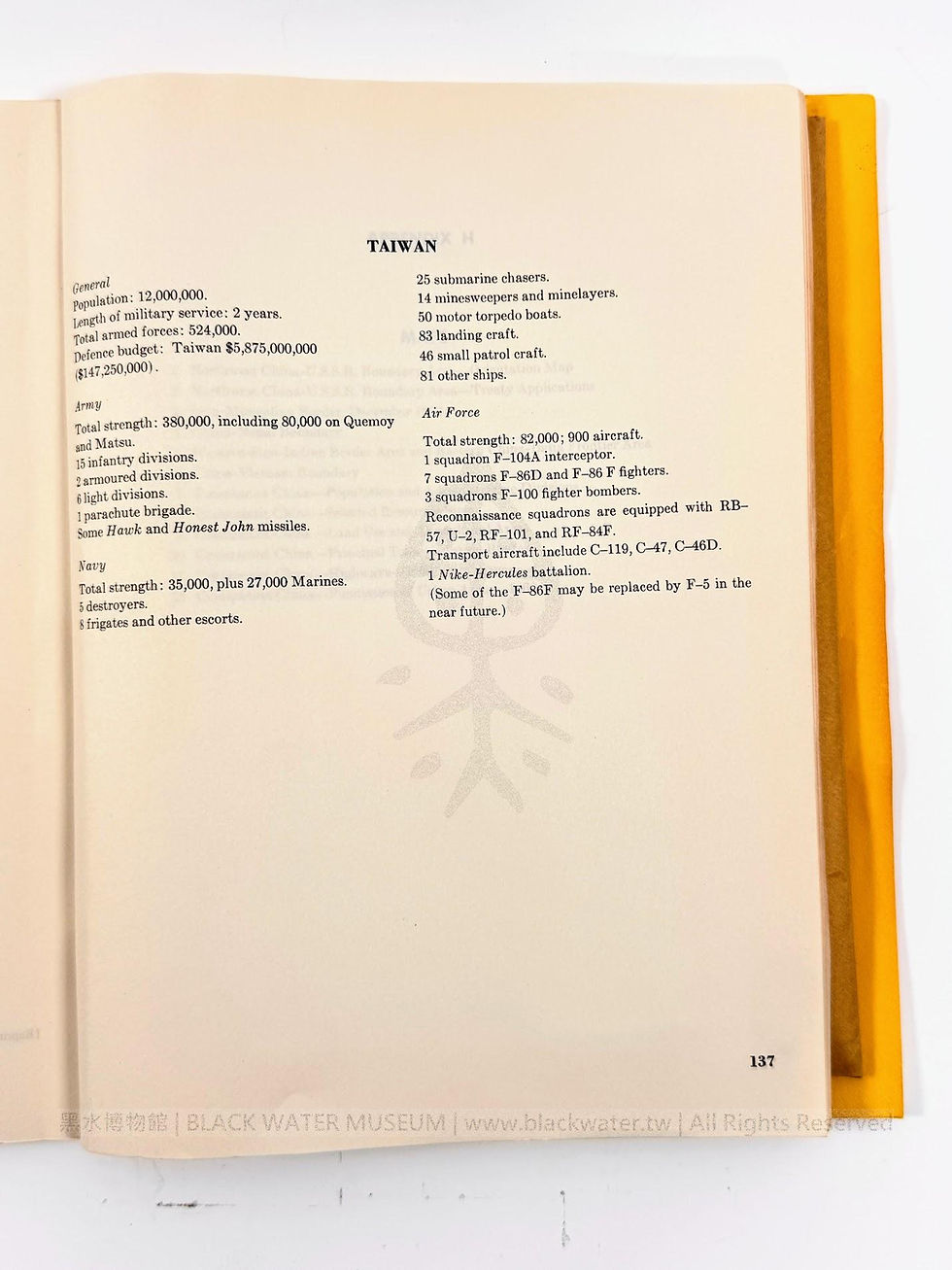
TAIWAN
General
Population: 12,000,000.
Length of military service: 2 years.
Total armed forces: 524,000.
Defence budget: Taiwan $5,875,000,000 ($147,250,000).
Army
Total strength: 380,000, including 80,000 on Quemoy and Matsu.
15 infantry divisions.
2 armoured divisions.
6 light divisions.
1 parachute brigade.
Some Hawk and Honest John missiles.
Navy
Total strength: 35,000, plus 27,000 Marines.
5 destroyers.
6 frigates and other escorts.
25 submarine chasers.
14 minesweepers and minelayers.
50 motor torpedo boats.
83 landing craft.
46 small patrol craft.
81 other ships.
Air Force
Total strength: 82,000; 900 aircraft.
1 squadron F-104A interceptor.
7 squadrons F-86D and F-86 F fighters.
3 squadrons F-100 fighter bombers.
Reconnaissance squadrons are equipped with RB-57, U-2, RF-101, and RF-84F.
Transport aircraft include C-119, C-47, C-46D.
1 Nike-Hercules battalion.
(Some of the F-86F may be replaced by F-5 in the near future.)
臺灣
一般概況
人口:12,000,000 人。
服役年限:2 年。
總兵力:524,000 人。
國防預算:58 億 7,500 萬台幣(約合 1 億 4,725 萬美元)。
陸軍
總人數:380,000 人,其中包含駐紮於金門與馬祖的 80,000 人。
15 個步兵師。
2 個裝甲師。
6 個輕裝師。
1 個傘兵旅。
配備部分「鷹式」(Hawk) 與「誠實約翰」(Honest John) 飛彈。
海軍
總人數:35,000 人,另有 27,000 人陸戰隊。
5 艘驅逐艦。
6 艘巡防艦及其他護衛艦。
25 艘獵潛艦。
14 艘掃雷艦與佈雷艦。
50 艘魚雷快艇。
83 艘登陸艇。
46 艘小型巡邏艇。
81 艘其他船艦。
空軍
總人數:82,000 人;900 架飛機。
1 個 F-104A 攔截機中隊。
7 個 F-86D 與 F-86 F 戰鬥機中隊。
3 個 F-100 戰鬥轟炸機中隊。
偵察中隊配備有 RB-57、U-2、RF-101 以及 RF-84F。
運輸機包含 C-119、C-47、C-46D。
1 個力士型 (Nike-Hercules) 防空飛彈營。
(部分 F-86F 可能在不久的將來由 F-5 取代。)

APPENDIX H
MAPS
Northwest China-U.S.S.R. Boundary Area—Orientation Map
Northwest China-U.S.S.R. Boundary Area—Treaty Applications
Sino-Mongolian Border, December 1962
China-Nepal Boundary
Western Sino-Indian Border Area and Eastern China-India Frontier Area
China-Vietnam Boundary
Communist China—Population and Administrative Divisions
Communist China—Selected Resources Sites
Communist China—Land Use and Agricultural Areas
Communist China—Principal Transportation Routes
Communist China—Highways—1960
Communist China—Population of Urban Areas—1960
附錄 H
地圖
中國西北與蘇聯邊界地區——方位圖
中國西北與蘇聯邊界地區——條約應用圖
1962 年 12 月中蒙邊境圖
中尼(尼泊爾)邊界圖
中印邊境西段區域與中印邊境東段區域圖
中越邊界圖
共產中國——人口與行政區劃圖
共產中國——選定資源分佈圖
共產中國——土地利用與農業區域圖
共產中國——主要交通路線圖
共產中國——公路圖(1960 年)
共產中國——城市地區人口圖(1960 年)


留言